When the sky ceases to be a backdrop and becomes a stage
To celebrate the ten years of the Masters de Feu, ARTEVENTIA wanted to avoid the trap of simply “bigger, stronger, more.” The idea was not to conclude the anniversary edition with a technological demonstration, but with a creation capable of summarizing ten years of history while opening a new chapter. Thus was born this nearly sixteen-minute closing show, imagined as a dialogue between 800 drones, pyrotechnics, light, and music.
However, the starting point was never the number. Eight hundred drones are impressive, of course. But for Édouard Grégoire, Artistic Director of ARTEVENTIA, this number only makes sense if it becomes a language. “The first question was never: what can we do with 800 drones? The first question was: what degree of precision and what story do we want to tell for the ten-year anniversary? The shapes, images, and transitions came later.”
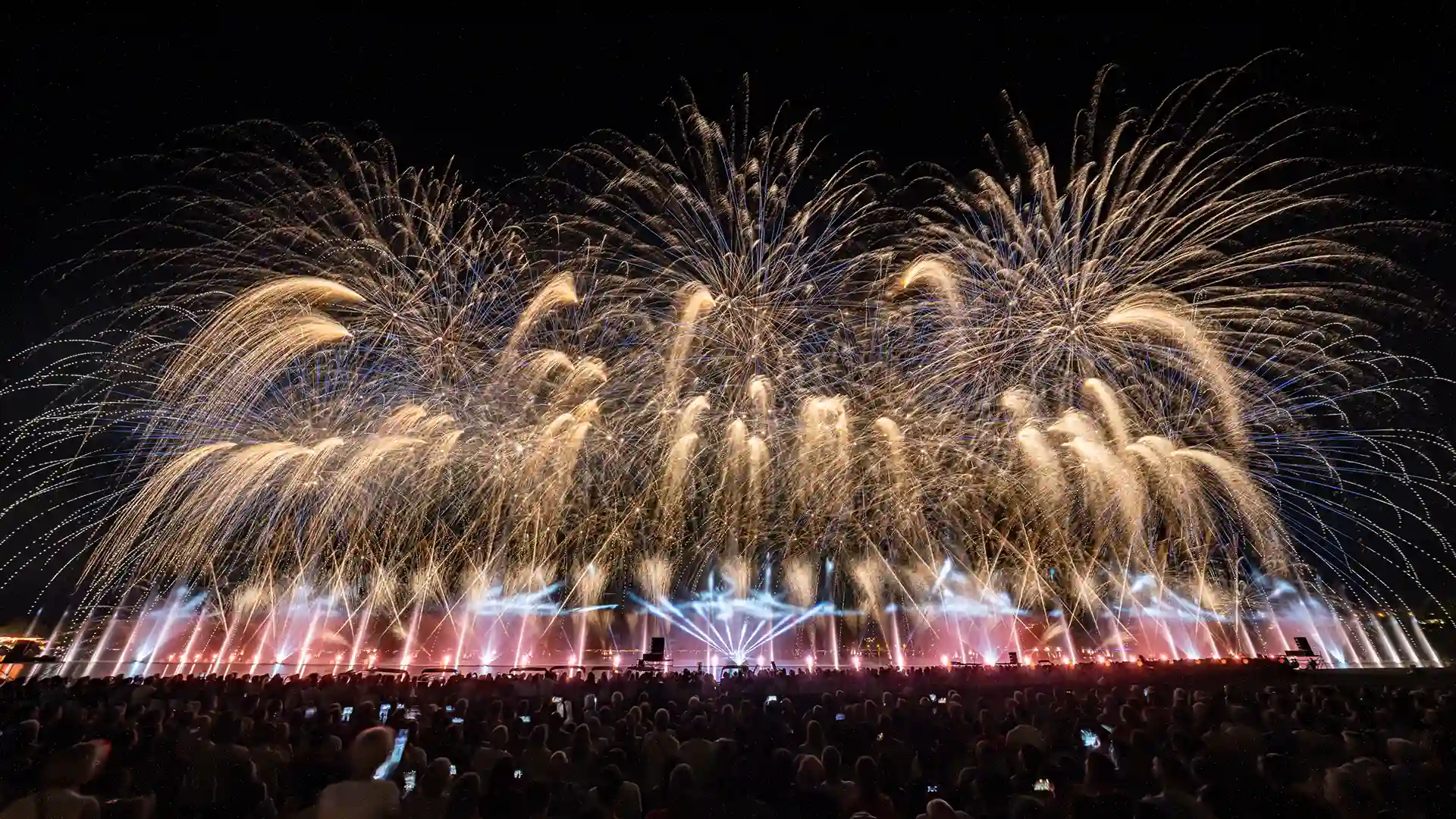
This way of thinking sums up the philosophy of Sky Choreography™ quite well. Drones are not viewed as a standalone attraction, nor as a succession of light pictograms intended to punctuate a fireworks display. They become a scenographic medium. An image can appear slowly, gain volume, transform, and endure over time. Pyrotechnics, by contrast, work with the moment, energy, and unpredictability. One is geometric, almost choreographic. The other is organic, vivid, and fleeting. The entire creation therefore rests on how these two artistic languages can meet without ever seeking to imitate each other.
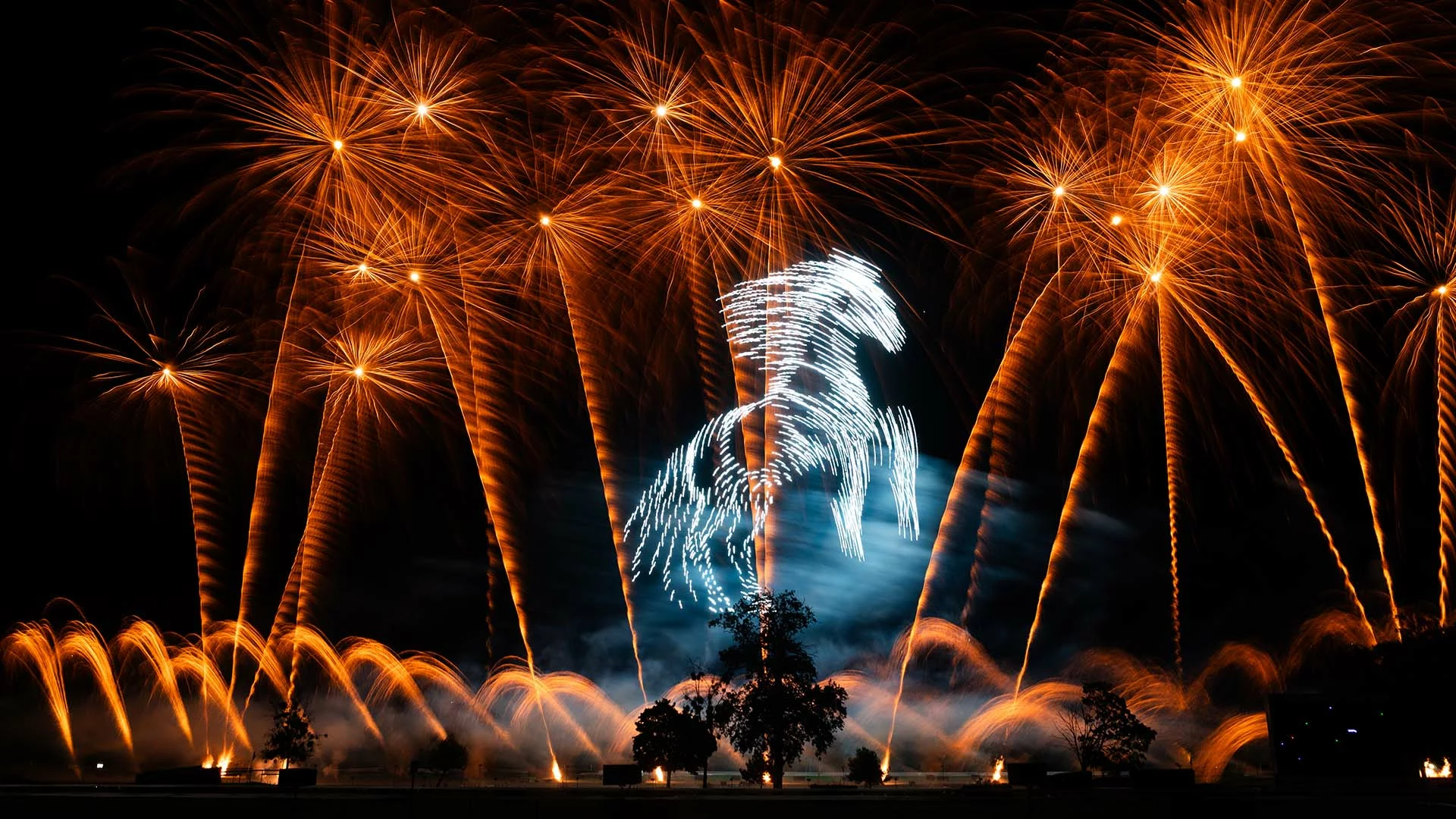
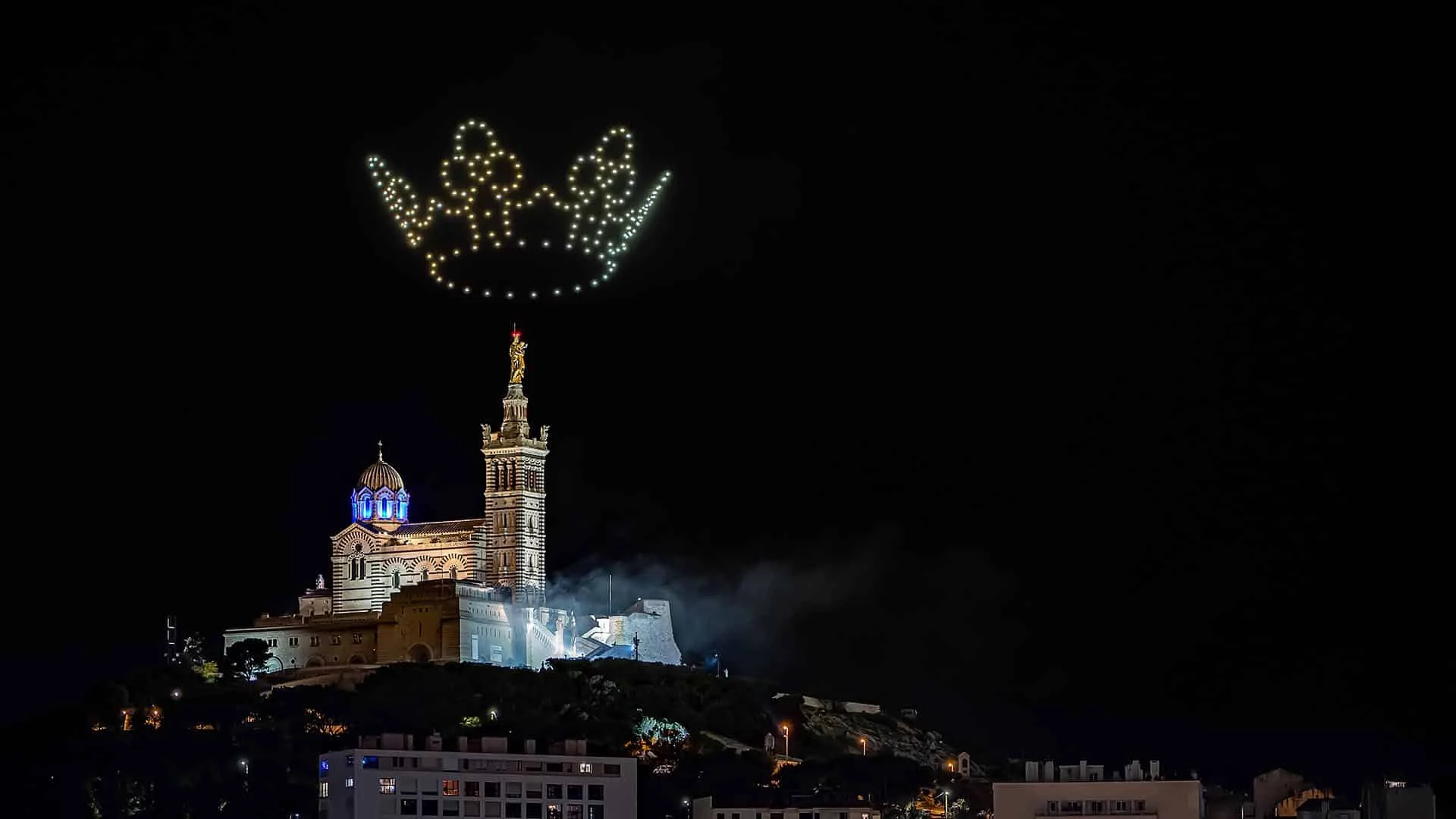
The show is built like a narrative. After a one-minute pre-roll, Hunter’s Mantra opens the first sequence, before The Hanging Tree – Epic Orchestra establishes a broader atmosphere. A century-old tree appears in the sky, like a memory suspended above the racecourse. Later, to Softly, a horse takes shape, followed by Ryomaden, which brings forth the Masters de Feu trophy and the flags of the countries that have marked the history of the competition. The show then slides toward a more spectacular image with Test Drive – Epic and the appearance of a firebird, before returning, to Time To Say Goodbye, toward something more intimate: the ten years, the logo, the end of a cycle.
This segment featuring the flags is one of the most symbolic. Since 2016, the Masters de Feu has welcomed teams from Italy, Spain, Austria, Belgium, Greece, the United Kingdom, Poland, Canada, France, Slovakia, Switzerland, Hungary, Germany, Romania, Finland, the Netherlands, and Portugal. Bringing these countries back into the sky was a way of condensing ten years of encounters into a few minutes. “I insisted that the ten years not be told solely through a number or a logo. The Masters exist primarily thanks to the teams who came to Compiègne with their culture, their style, and their way of thinking about fire. This sequence was a way to bring them back symbolically into the show.”
The collaboration with Magic Drone plays an essential role here. Because between an idea drawn on a screen and a truly legible shape in the sky, there is a whole process of adaptation. A silhouette may seem obvious in simulation but become too complex once placed several hundred meters from the audience. A transformation may appear fluid on a computer and require more time in real flight conditions. Each image must therefore be designed with the constraints of trajectory, speed, positioning, battery life, and safety.
This is where artistic direction meets technical reality. “We can imagine something very beautiful on a screen, but if the image isn’t legible from the audience’s perspective, it doesn’t work. We must constantly arbitrate between the purity of the idea and how it will actually exist in space.” This adaptation phase does not come after the creation; it is part of it. Some shapes evolve, others are simplified, and some transitions are lengthened to gain fluidity. Technology does not dictate the show, but it imposes a framework that the writing must know how to integrate.
With 800 drones, the scenography becomes almost architectural. We are no longer just talking about drawings, but about width, depth, mass, perspectives, and reading time. A shape that is too small loses its impact. An image that is too dense becomes difficult to understand. A sequence that is too fast can prevent the audience from grasping what they are watching. The challenge is therefore to build pauses, to let certain images exist, and then to make them disappear at the right moment to open up the space for pyrotechnics or light.
“It’s quite similar to traditional scenography work,” explains Édouard Grégoire. “We organize volumes, scale relationships, movements, and perception times. The difference is that this time, our stage is in the sky.”
Light plays precisely this connecting role. It does not seek to become a third technical demonstration, but to link the different layers of the show, to extend certain transitions, and to reconnect the sky with the racecourse site. It also helps avoid having every scene rely systematically on a new spectacular effect. In a creation of nearly sixteen minutes, rhythm is as important as power. You have to know how to fill the space, then empty it. Create a surprise, then let it breathe. Give the audience a very legible image, then return to something more abstract.
This relationship to rhythm becomes particularly important in the final movement. After the firebird figure, the show does not simply seek to “end stronger.” It changes register. Time To Say Goodbye establishes a different emotion, almost a farewell. “A closing show must give the feeling that something is truly ending. For the ten-year anniversary, I wanted that after all the power and technology, we arrive at a more human, more emotional moment.”
This is perhaps what best summarizes this creation. The 800 drones are the figure people remember. The pyrotechnics and light provide the scale. But the show was never intended as a demonstration of means.
It tells a story—that of a competition that has grown for ten years, that of teams from all over the world, that of a loyal audience, and that of a sky that new technologies now allow us to write differently.
In the end, the drones disappear, the pyrotechnics go out, the light fades. And only one image remains.
This is precisely what Sky Choreography™ seeks to create.