Just days before the Fête du lac d’Annecy, technical teams and pyrotechnicians are already busy on the lake shores bringing to life one of Europe’s largest pyrotechnic shows. Behind the barges, the kilometers of cables, and the thousands of pyrotechnic devices that will soon be deployed lie months of reflection, creation, and preparation. But how is a pyrotechnic show actually created? From the first idea to the final burst, we invite you to discover the secrets behind the conception of a monumental production.
It all begins with an idea
Before the music, the site plans, the firing lines, or the first simulations, there is always an idea. A guiding thread that will give meaning to the whole and transform a succession of pyrotechnic effects into a true artistic creation.
For the Fête du lac d’Annecy 2026, this idea is titled “The Soul of the World.” A theme conceived as a sensory journey where music becomes a universal language, capable of connecting cultures, generations, and emotions. It is around this backbone that the entire show was built.
“The theme is the guiding idea of any creation. It gives the show its identity and guides each of our artistic choices,” explains Édouard Grégoire, artistic director of ARTEVENTIA. “Before even choosing music or a pyrotechnic effect, you need to know what you want to tell, what emotions to convey, and what memory you want to leave with the audience.”
From this first impulse begins work that will extend over several months. A creative adventure far longer than the 70 minutes the audience will experience on the evening of the show.
The venue, the first constraint of the writing
A pyrotechnic show is never conceived independently of the venue that hosts it. And few stages are as demanding as Lake Annecy.
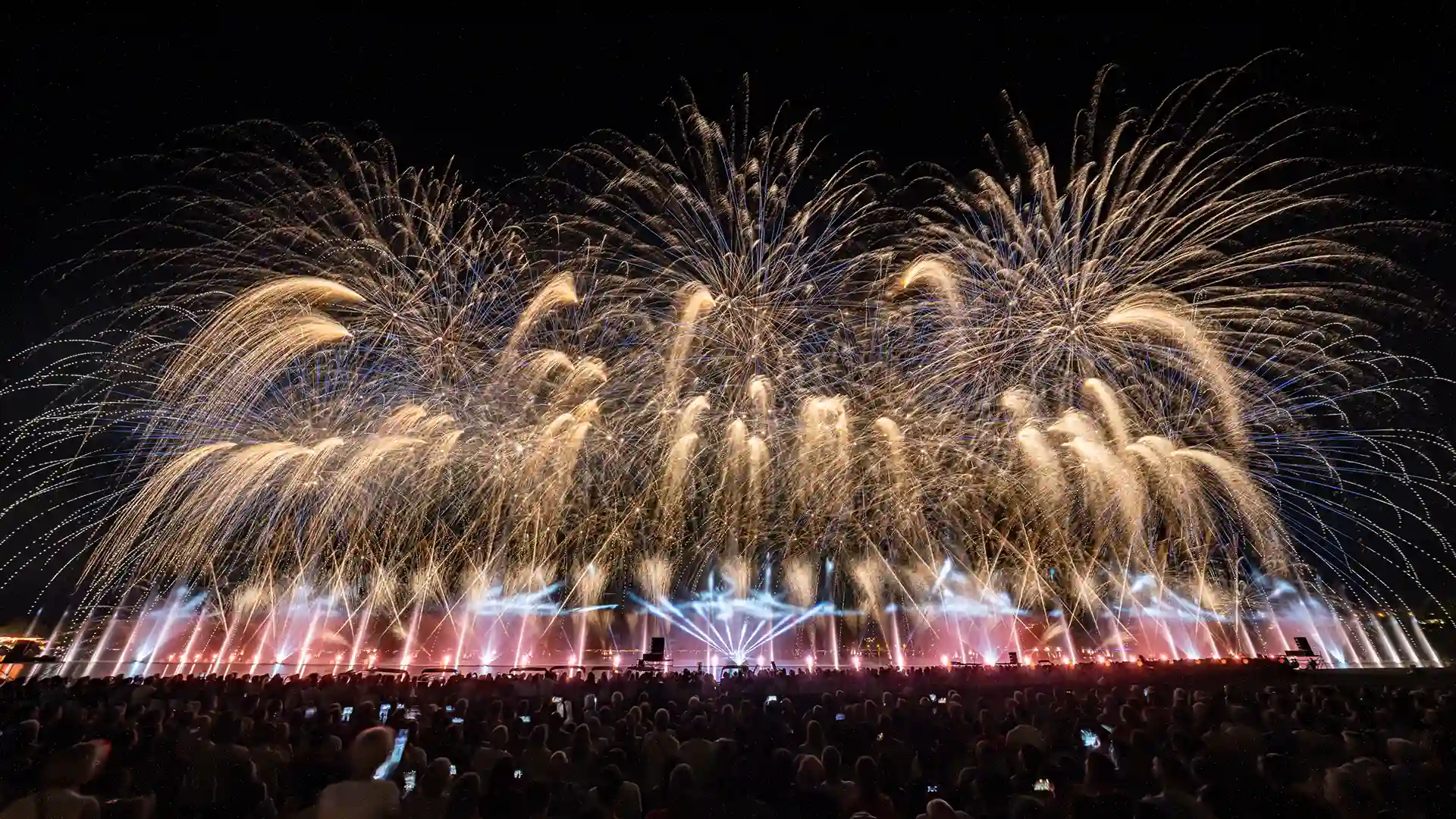
Across nearly 900 meters of frontage, pyrotechnicians must work with barges installed on the water, the surrounding terrain, the depth of the body of water, and the hundreds of thousands of spectators distributed all around the lake. Each effect is designed with these constraints in mind to offer optimal viewing, regardless of vantage point.
“The venue determines the effects we can deploy. An idea may seem perfect on paper but not work in a given environment. You have to understand the volumes, the distances, and how the audience will perceive each sequence.“
At Annecy, the lake is not merely a backdrop: it is an integral part of the staging.
Drawing from the theme before beginning to write
Once the theme is defined and the site analyzed, the show is not written immediately. The idea must first be allowed to develop.
The designer explores images associated with the subject, reflects on the emotions they wish to evoke, the message they want to convey, and the overall progression of the narrative. They imagine movements, contrasts, moments of power, and more suspended moments.
“You have to draw from the theme to bring it to life,” summarizes the artistic director. “This involves selecting music, but also silences, movements, emotions, and how the show will evolve in space.”
This preparatory work can be difficult to quantify. Some ideas emerge quickly. Others require more time and several attempts before finding their final form.
Inspiration obviously plays a role, but it is not enough. Behind each sequence also lies extensive technical reflection: which effects to use, with what intensity, at what height, across what width, and at what precise moment in the music?
Hundreds of tracks for a few minutes of soundtrack
Music is one of the primary materials of pyrotechnic writing.
Throughout the year, Édouard Grégoire listens to and organizes numerous tracks into thematic playlists. A method that allows him to maintain a reserve of ideas for future projects.
“When I hear music, I can immediately associate it with a theme or atmosphere. I then place it in a playlist, even if I don’t yet know when it will be used. It’s a considerable time-saver when beginning a new creation.”
This personal library does not replace the research specific to each show. For the few tracks ultimately selected, it may be necessary to listen to several dozen, or even a hundred.
All must harmonize, despite their respective rhythms, orchestrations, and universes. The soundtrack must form a coherent whole, with genuine dramatic progression, not simply a succession of titles.
Some music immediately offers anchor points for pyrotechnics. Others require more finesse. Breathing spaces, orchestral builds, breaks, or even silences become reference points for constructing the show.
Sketching, drawing, simulating… then letting it rest
There is no single way to develop the storyboard of a show.
Plans, sketches, notes taken on the fly, drawings, simulation software: all media can be used. The most refined ideas are not always born in front of a screen. Some appear in a notebook, during a journey, or following an image glimpsed almost by chance.
“I sketch, I make plans and simulations. I use every possible medium,” recounts Édouard Grégoire. “Sometimes you have to start over completely. But the most difficult part is often letting the idea settle, taking a step back, then rediscovering your own project with fresh eyes.”
This distancing is essential. After working several hours on the same sequence, the designer can become trapped by their initial intention, to the point of no longer perceiving its weaknesses.
The project must then be set aside, for a few hours or a few days, before being revisited. This apparently unproductive time is fully part of the creative process.
When software becomes both an ally… and a trap
Today, digital tools make it possible to construct and simulate the show with remarkable precision. Each effect, each color, and each ignition can be visualized before assembly even begins.
For “The Soul of the World,” this stage represented several months of work to orchestrate all the tableaux, balancing pyrotechnic effects, drones, water features, lighting, and music.
“Software is a formidable creative tool, but it can also become the enemy of time. Since everything is modifiable, you constantly seek to perfect every detail.“
A simulation, however, remains a virtual representation. Wind, actual volumes, smoke, and perspective always transform the final result. Experience allows you to distinguish between what works on a screen… and what will truly captivate hundreds of thousands of spectators.
Music dictates colors and texture
Selecting pyrotechnic devices is not simply about matching a shape to a musical moment.
The color, brilliance, duration, and density of each effect contribute to the emotional writing of the show.
“It’s the music that guides my choices,” explains the artistic director. “It will determine the effects, the colors, the desired brilliance. Silver can provide great luminous power, while gold offers more nuance and sensuality.”
The same musical note can be translated by a very wide opening, an isolated effect, a lateral movement, or a gradual appearance. The work consists of giving visible form to an auditory sensation.
The rhythm of fire must not simply follow that of the music. It must dialogue with it, sometimes accompanying it very precisely, sometimes taking the lead, or deliberately leaving space for breathing.
Writing a show also requires being a pyrotechnician
Artistic creation cannot be separated from technical mastery.
For Édouard Grégoire, it is essential to have experience as a pyrotechnician to design a show. This knowledge allows you to anticipate risks, understand the real possibilities of products, and avoid writing a sequence that is impossible to execute.
Once the show is completed in the software and technically transcribed, the fieldwork begins.
“The pyrotechnician’s craft truly comes into play when the creation arrives on site,” he specifies. “It’s the penultimate movement of an already extensively worked score.”
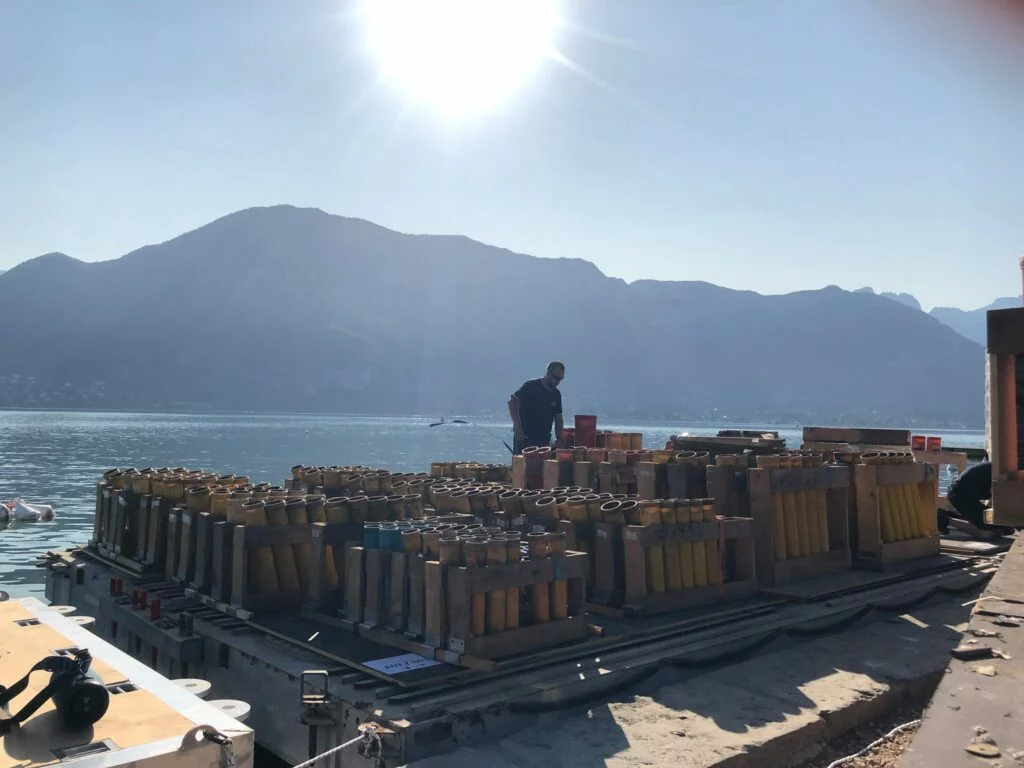
The teams must then prepare the equipment, install the supports, set up the products, perform the cabling, and verify the thousands of connections that will allow the show to unfold according to the initial writing.
The designer imagined the movement. The pyrotechnicians give it physical existence.
A personal creation, supported by collective work
Writing often begins in solitude.
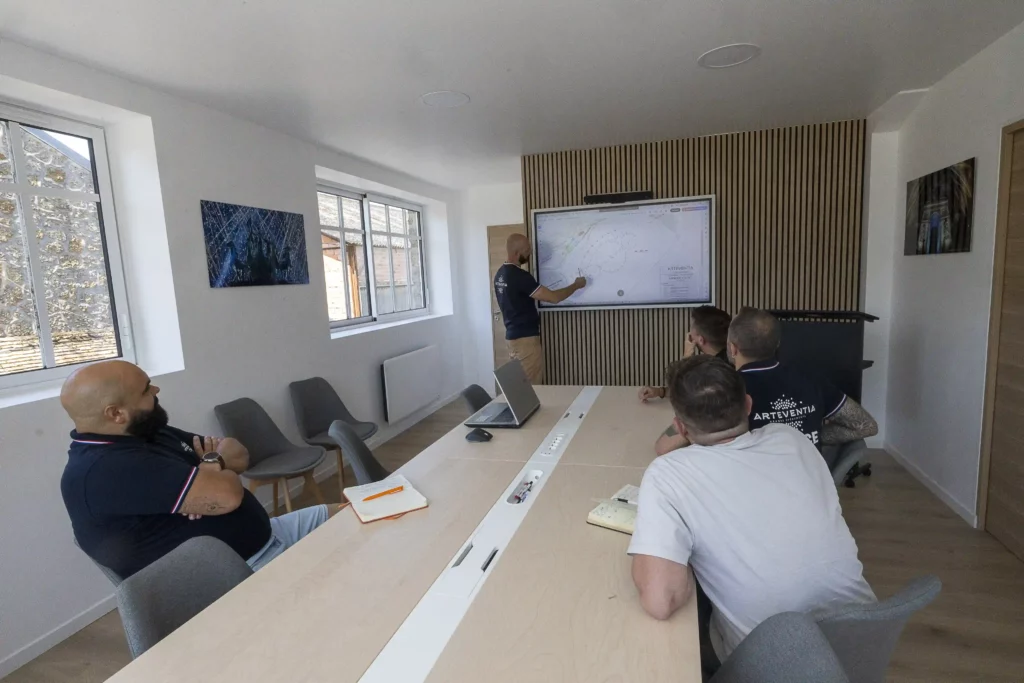
To avoid multiplying possible directions too early, Édouard Grégoire prefers to develop the initial artistic intention alone. Collective work comes later, particularly when defining the site layout and translating the project on the ground.
Gabriel Legrand, Adrien Teixeira, and the other technical managers can then propose a plan, suggest an adaptation, or draw attention to a constraint that the writing had not sufficiently anticipated.
“I also sometimes ask for their opinion when I’m trapped by my idea and can no longer gain the necessary perspective,” he confides. “Creative work can be psychologically demanding, especially when time or energy begins to run short.”
The exchange then allows for regaining a clearer vision, without distorting the initial project.
Generally, the first idea remains the right one. It has even become something of a motto. But it must sometimes be adapted to make the show feasible, more readable, or more impactful.
9,500 lines of programming for 70 minutes of show
At the Fête du lac d’Annecy, the numbers give an idea of the project’s scale.
The 2026 edition represents 70 minutes of original creation, orchestrated through nearly 9,500 lines of programming, enabling the synchronization with extreme precision of more than 10,800 pyrotechnic ignitions, as well as lighting effects, water jets, drones, and all the scenic elements that compose the show.
Each line of script corresponds to one or more actions: triggering an effect, its position on the lake, its orientation, its synchronization with the soundtrack, or its articulation with other tableaux. A true digital score where every tenth of a second counts.
When this writing is definitively validated, the work changes in nature. The designers hand over to the technical teams, who take possession of the lake to install the barges, firing systems, kilometers of cables, and thousands of pyrotechnic devices necessary for the performance.
For the artistic director then begins a quieter period, filled with waiting, excitement… and doubts.
“The last week is always particular. You wonder if the audience will feel the emotions you wanted to convey, if the transitions will work as imagined, if everything will unfold as planned. Then comes the first ignition. At that moment, the show no longer belongs to us. It belongs to the audience.“
Emotion cannot be measured
After several months of work, thousands of lines of programming, and the involvement of several dozen people, everything ultimately comes down to a few minutes.
The objective, however, is not to demonstrate the technical complexity of the project. The audience does not need to perceive the calculations, the constraints, or the hours spent in front of the software. They simply need to feel something.
“You must not be afraid to open your heart and emotions,” affirms Édouard Grégoire. “Emotion is not quantifiable.”
This is perhaps the main difficulty of this profession: mobilizing an extremely precise organization to obtain a result that, itself, escapes all measurement.
A creation can be technically flawless and leave the audience at a distance. Another, simpler one, can provoke silence, a shiver, or spontaneous applause.
This element of the unexpected accompanies every show.
When one idea already calls for another
Creative work does not always end with the final burst.
Ideas sometimes emerge without warning, long before a project is associated with them. Édouard Grégoire has learned to note them down so as not to lose them. An image, a movement, or a musical association can remain in a notebook for several months before finding its place.
It even happens that a new show begins to take shape just as the previous one has barely concluded.
The audience sees seventy minutes in the sky. Behind them lie several weeks or months of creation, dozens of professionals, and a considerable number of hours of work.
Then the lights go out. And, somewhere, a new idea has already been born.
Also worth reading:
Pourquoi les concours internationaux transforment l’écriture d’un spectacle