Jean-Michel Jarre in Brussels: when effects become music
On July 1, 2025, the Place des Palais hosts a concert that, even before it begins, carries a certain idea of the grand spectacle.
Jean-Michel Jarre returns to Belgium after nearly ten years of absence for the Brussels Palace Open Air, a new musical event set against the Royal Palace. The day before, Neil Young opened the series. The following day—or rather that evening, at 10 PM—it is the French pioneer of electronic music who takes possession of the site for a show lasting nearly an hour and a half.
For ARTEVENTIA, the challenge is obviously not to add a few effects to an already spectacular concert. It is about entering an existing visual language, that of an artist whose work has always combined electronic music, light, monumentality, and scenography.
“With Jean-Michel Jarre, the visual dimension is never incidental. It is part of the music. Our work therefore had to integrate into this logic, not be superimposed upon it,” explains Édouard Grégoire, artistic director of ARTEVENTIA.
The nuance is important.
In a traditional concert, special effects can sometimes be thought of as punctuation: an impact, a build-up, a finale. Here, they participate in a much more global architecture. The fire must accompany the music, dialogue with the lights, prolong the movements on stage, and sometimes accept disappearing to let other elements take over.
This is precisely what makes this type of collaboration fascinating.
Jean-Michel Jarre has built part of his legend on monumental concerts capable of transforming squares, monuments, or entire landscapes into stages. His appearance in Brussels follows this lineage, with a setup announced as retro-futuristic and designed to reconnect with the great shows that have marked his career.
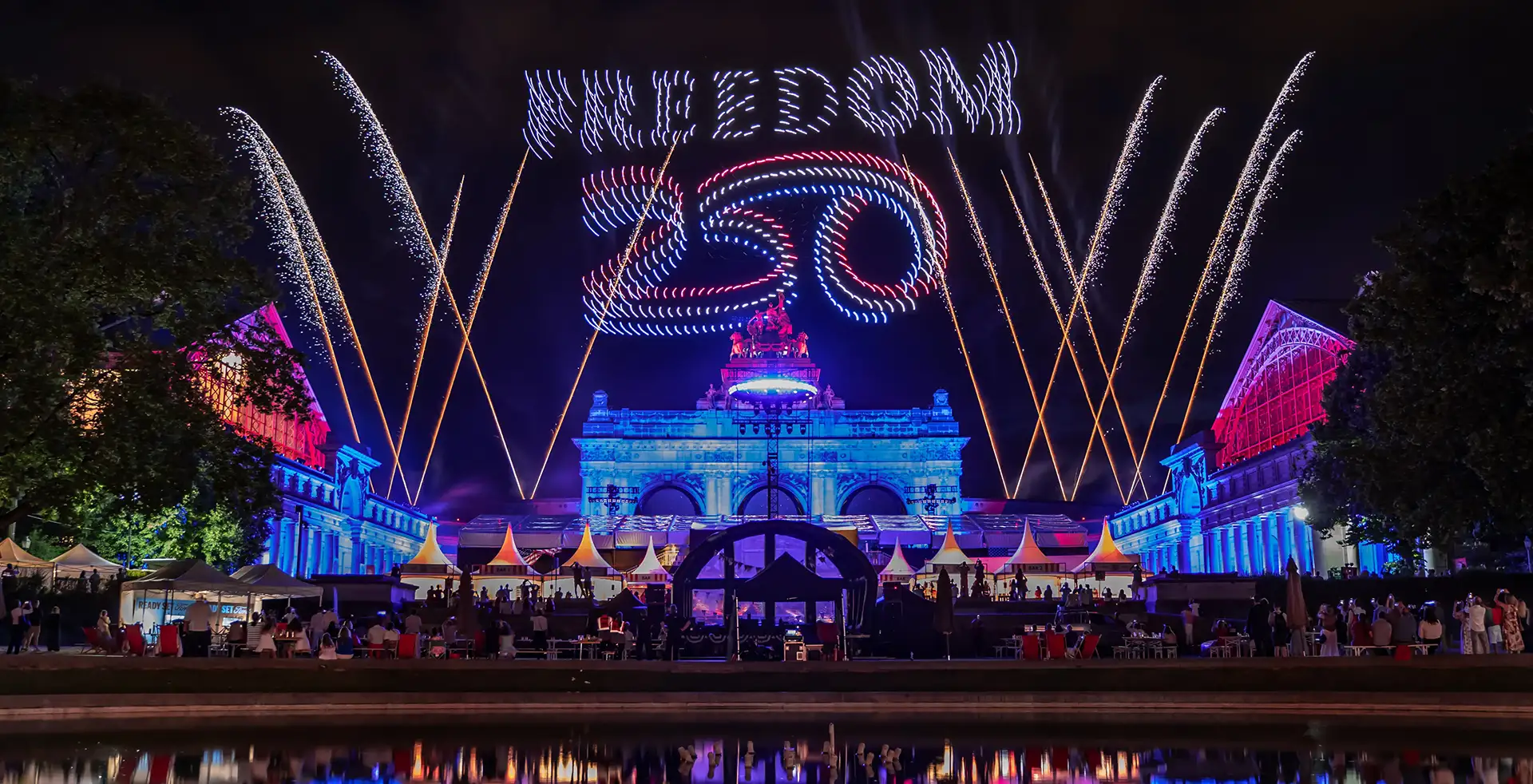
On the Place des Palais, the architecture adds an additional constraint. The facade of the Royal Palace remains constantly present. The audience finds themselves in an urban space steeped in history, facing a contemporary stage where electronics, light, and effects mingle.
“We always work with the venue, even when intervening in a concert. Here, the Royal Palace remains in the field of vision. The show must be able to exist with this architecture, without giving the feeling that we simply placed a stage production in front of it.”
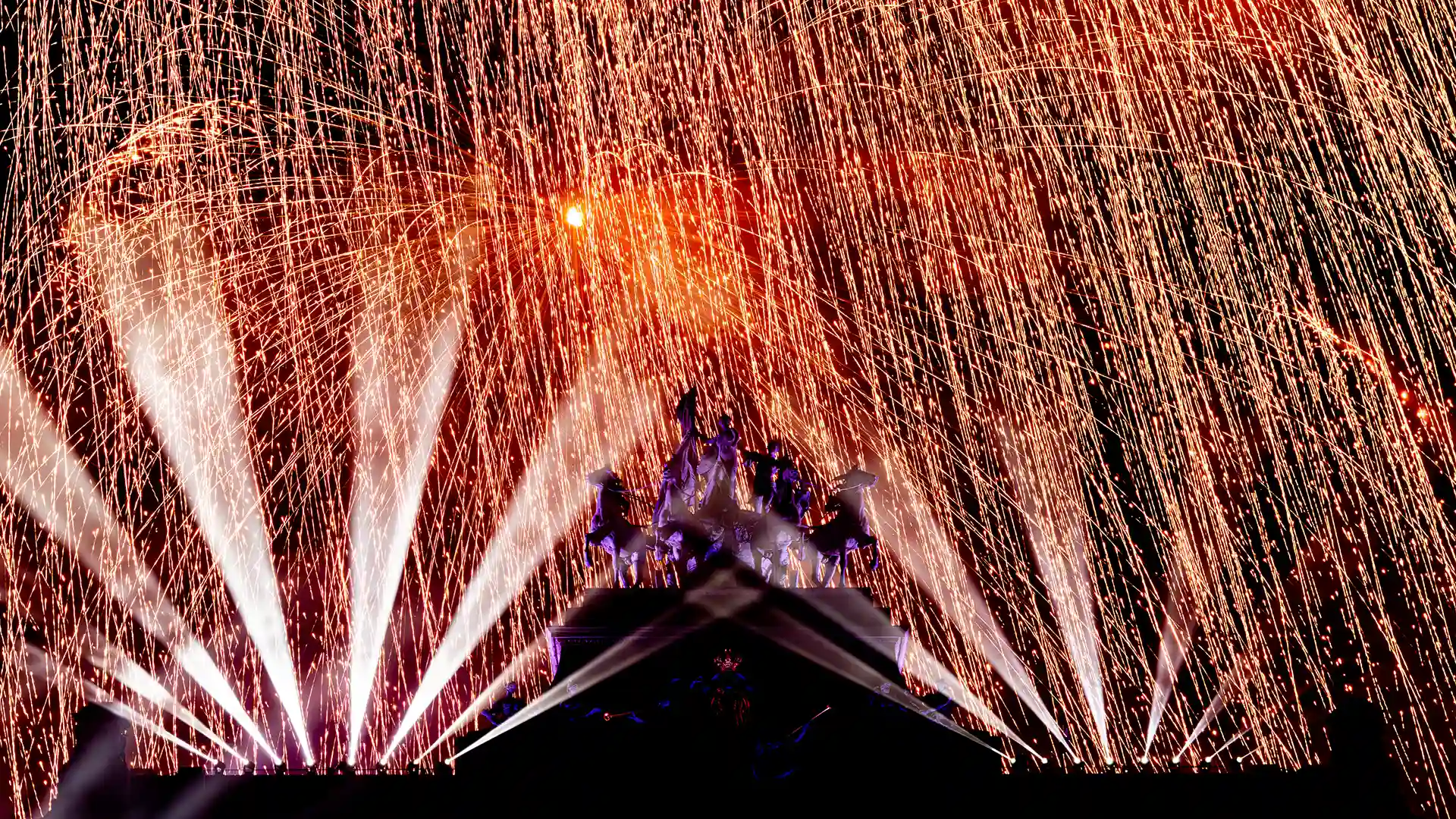
Flame effects find their place particularly well in this configuration. More organic than light, more durable than an instantaneous pyrotechnic effect, they allow certain musical impulses to be prolonged and give the stage an almost physical presence.
Pyrotechnics work differently. It intervenes on precise accents, changes in intensity, moments where the music calls for an immediate break or expansion.
Both, therefore, possess neither the same rhythm nor the same function.
And it is precisely their complementarity that gives the concert depth.
“An effect should never be there just because it is impressive. It must happen because the music calls for it. Sometimes, a few seconds of flame are enough. At other moments, a much sharper break is needed. It is always the dramaturgy of the live show that decides.”
This approach also requires particular precision. When a show is entirely synchronized to a musical performance, the slightest trigger must fall at the right instant. A few tenths of a second can be enough to transform a perfectly integrated effect into an element that seems to arrive too early or too late.
The technique then becomes almost choreographic.
Each trigger has its place in the score.
Each flame, each pyrotechnic effect, each build-up must find its point of contact with sound and light.
This is probably what best summarizes ARTEVENTIA’s intervention on this project: not creating a show around the concert, but entering inside the concert.
This logic is also a demonstration of what work on major live shows represents today. The artist arrives with a universe, an identity, a staging, a dramaturgy, and an aesthetic that are already very well-defined. The role of special effects is therefore not to steal the spotlight.
It is to reinforce what exists.
To prolong a note.
To accentuate a rhythm.
To transform the perception of the stage for a few seconds.
Then to disappear.
On the Place des Palais, this restraint is all the more important as Jean-Michel Jarre’s universe is already profoundly visual. The challenge was not to multiply the signals, but to know when to intervene.
“On this kind of production, success often depends on precision more than quantity. You have to know how to choose the moments that truly deserve an effect. The rest of the time, you have to let the concert breathe.”
Throughout the evening, the fire effects and pyrotechnics thus punctuate the performance without ever seeking to distract from it.
The music remains the center.
The show is built around it.
And when the fire appears, it seems simply to prolong what the audience is already hearing.
That is perhaps where the effects become truly interesting.
When we stop looking at them as effects.
And they become, in turn, a form of music.
Photo credits: Nicolas Guilitte