Clément Sauvage: Capturing the Ephemeral to Create Lasting Memories
In the world of pyrotechnic shows, certain presences accompany the magic without ever seeking to steal it. They observe it, await it, understand it, and then transform it into images capable of extending the emotion long after the final burst. Clément Sauvage is one of them.
A passionate photographer—an enlightened amateur, as he modestly likes to remind us—Clément has been developing a distinctive perspective on pyrotechnic shows for several years. A precise, graphic, demanding perspective, yet always deeply connected to what the location, light, and moment tell together. For him, photographing a fireworks display is not simply about capturing an explosion of colors in the sky: it is about revealing what the eye does not always have time to see.
A Dual Universe: Between Rigor and Passion
Clément is 35 years old, and his daily life is divided between two worlds. By day, he is an entrepreneur and computer engineer. By night, he devotes himself to his passions: photography and guitar. Two seemingly very different territories of expression, but which share the same demands of rhythm, sensitivity, and precision.
For him, photography is above all a story of transmission. A passion born very early, almost naturally, in his father’s footsteps. His father practiced photography extensively, even developing his own prints. It was by borrowing—or more precisely, by “swiping”—his Canon, around the age of 10 or 12, during family outings, that Clément began to build his vision.
A childhood curiosity that became, over time, an attentive practice, nourished by observation, technique, and the intact pleasure of seeking the right image.
From First Firecrackers to Discovering Grand Spectacles
Like many lasting passions, Clément’s love for pyrotechnics is rooted in very simple memories. First, there were the firecrackers bought with pocket money, the first escalations, the rockets, the single shots, and this growing fascination with pyrotechnic material.
Then came a pivotal moment: the July 14, 2011 fireworks in his town. A turning point. Shortly after, he discovered the television program C’est pas Sorcier dedicated to the Chantilly fireworks, which opened another door for him: that of technical and scientific understanding of the show. His perspective sharpened. His interest deepened.
His first true festival fireworks would be in Cannes, in 2017. That same year, he also discovered the Masters, through the Facebook group of alumni from his engineering school. From that point on, his connection to this world would only strengthen.
The First Photographed Fireworks: Learning Through Instinct
Clément remembers very well the first show he photographed. It was August 15, 2016, on the beach of Malo-les-Bains, in Dunkirk. He was with his mother, without a tripod, with a camera he himself describes as modest, and without real mastery of the settings.
In other words, under conditions far from ideal.
And yet, he retains a very vivid memory of it. Perhaps because in this type of first time, there is already something foundational: the desire to capture, to retain, to understand what escapes. Even without all the tools, even without all the technique, the intuition was already there.
When Pyrotechnic Photography Becomes a Discipline in Its Own Right
It was after the COVID pandemic, when shows resumed, that Clément fully measured the place this practice occupies in his life. The lack he felt was not only that of the spectator, but also that of the photographer. He then understood that what he sought in these events went beyond the simple pleasure of watching: he wanted to photograph them with more intention, precision, and rigor.
It was at that moment that pyrotechnic photography became a true specialty for him.
A discipline with its own constraints, demands, language, and temporality. A practice that is both technical and sensitive, in which each image is constructed in uncertainty, between mastery and surprise.
Photographing Light, but Above All the Location
What distinguishes pyrotechnic photography from other disciplines, in his view, is this unique tension between two opposing temporalities: the slowness of long exposure and the suddenness of the instant. You do not trigger in the usual sense of the term. You open, you wait, you close. Each image becomes an accumulation of light constructed in darkness, without absolute certainty about the final result.
It is precisely this element of the unprecedented that fascinates him.
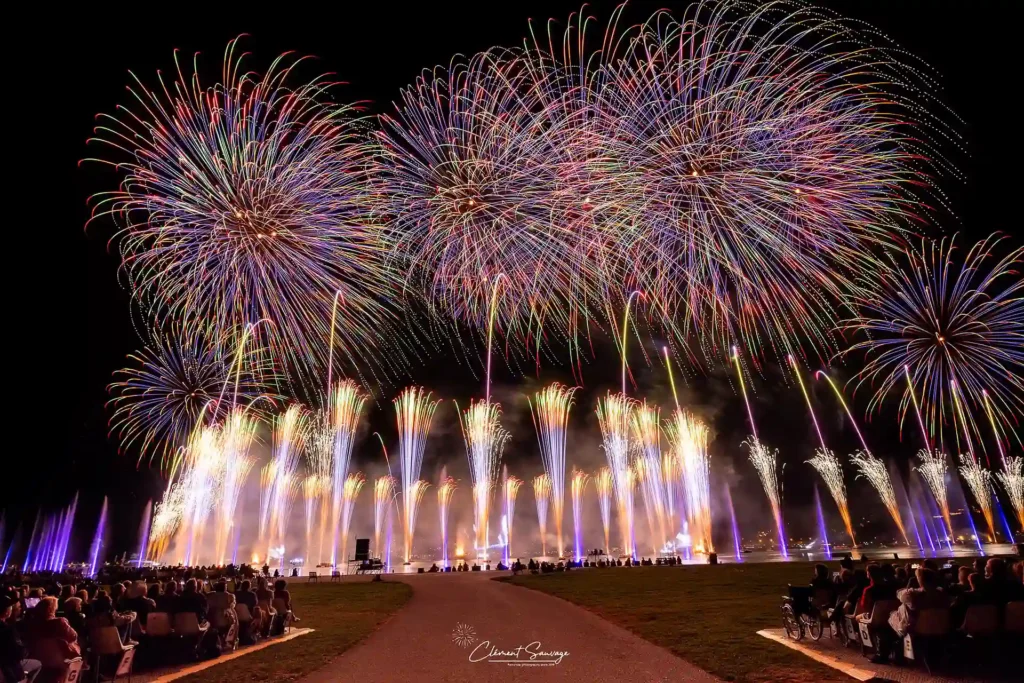
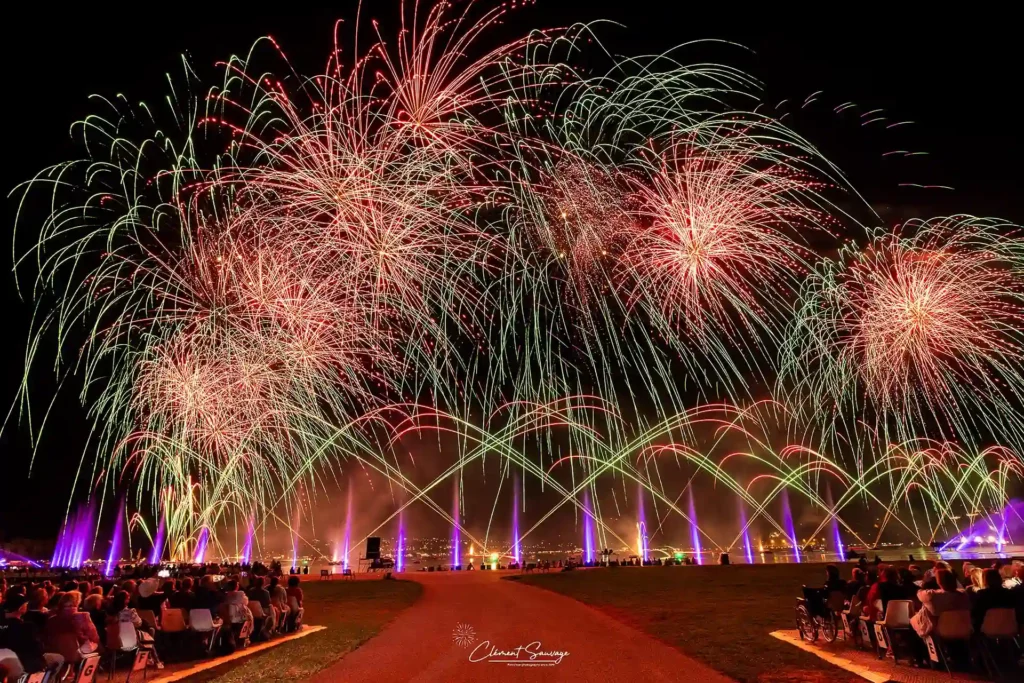
But in his approach, the fireworks themselves are never enough. If his images often impress through their visual power and graphic precision, it is the overall atmosphere of the location that takes priority above all. For him, an image of fireworks without context may be appealing, but it remains incomplete. What interests him is the dialogue between the bursts and an architecture, a body of water, a crowd, a silhouette, a presence.
The setting is never a simple backdrop. It is a character in its own right.
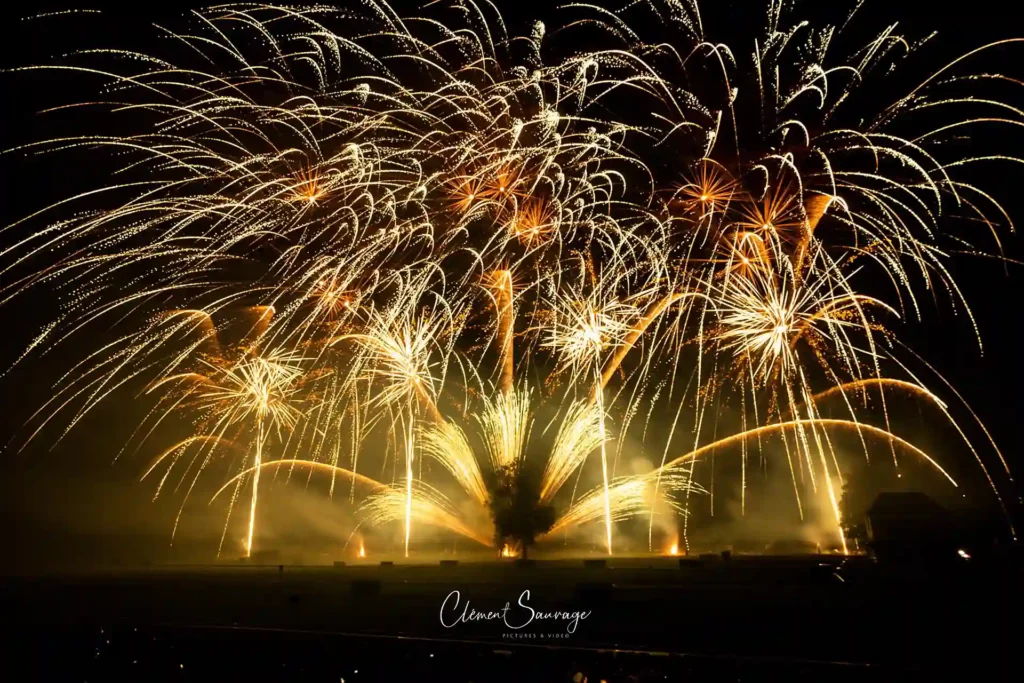
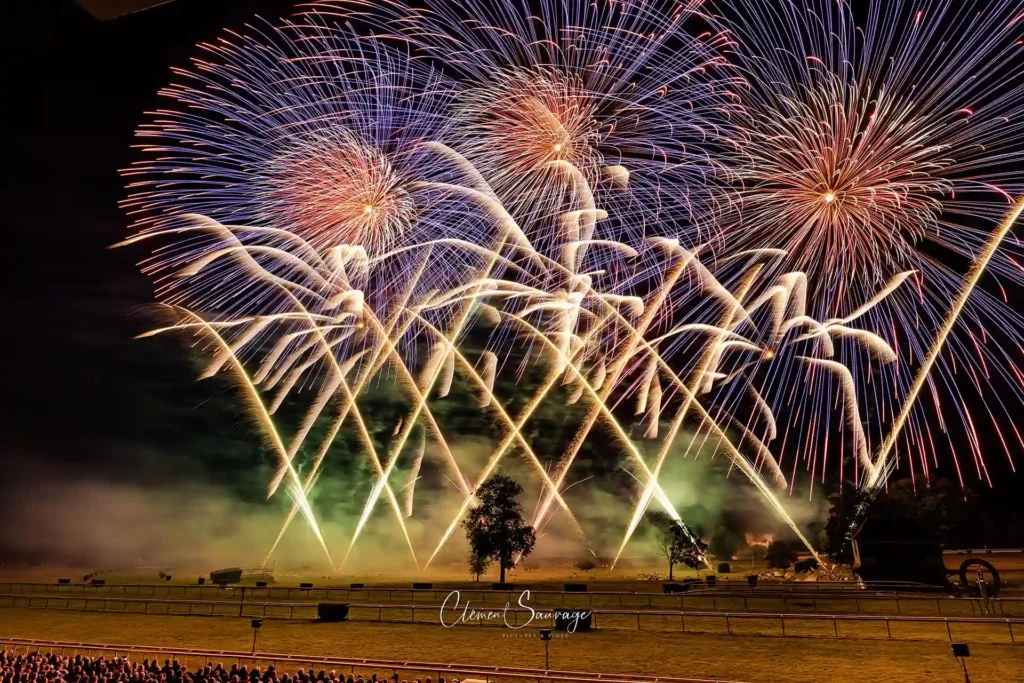
At the Compiègne hippodrome, during the Masters de Feu, for example, he readily incorporates the site’s central tree into his compositions, as an identifying landmark of the location. In Cannes, he seeks to convey the Croisette, the Mediterranean, that very particular southern light. Everywhere, he works with the idea that the fireworks last a few minutes, but the location carries a much longer memory.
A Photographic Language Constructed Before the First Burst
Clément’s images often give an impression of solidity, balance, almost architectural composition. This is no accident. For him, everything is decided beforehand. He arrives early, scouts locations, tests several positions, works his frames with the wide-angle lenses he particularly favors, notably the 14-35mm and 10-20mm, in order to incorporate maximum context without losing the readability of the fireworks.
He seeks vanishing lines, symmetries, depths, visual anchors.
Once the show has begun, he no longer moves. The frame is set. The photography then unfolds in managing the exposure, in choosing the right moment to open and close, in intuition regarding the density of the burst. The composition has already been conceived.
This methodical approach does not prevent freedom. It makes it possible. Clément likes to say that he anticipates as much as he can and improvises on what he could not anticipate. The fireworks remain alive, mobile, subject to wind, smoke, and the surprises of reality. One must therefore prepare solidly to remain flexible.
Faithful to the Spirit of the Show, Not Its Strict Reality
Clément does not seek to literally reproduce what a spectator saw. And he fully accepts this. Pyrotechnic photography, by the simple fact that it employs long exposure, is already an interpretation. It adds effects that the human eye never perceives simultaneously.
For him, this is where artistic expression begins.
Being faithful to a show does not mean copying its instantaneous reality, but rather conveying its spirit, tension, and profound beauty—sometimes even revealing what was not perceptible in the moment. A striking photograph is therefore, in his view, an image that survives the event. An image that does not merely appear beautiful “in the moment,” but remains identifiable, memorable, charged with atmosphere.
An image in which one recognizes a location, an evening, an energy.
Demanding Technique in Service of Emotion
Clément works exclusively on a tripod, with remote triggering to avoid the slightest micro-blur. He uses Canon EOS R and R5 bodies, which offer him valuable latitude in post-processing, while remaining extremely attentive to settings from the moment of capture.
Low ISO, aperture generally between f/8 and f/11, Bulb mode to control the duration of each exposure as precisely as possible: his method relies on precision and constant adaptation to the density of the fireworks.
For him, the main difficulty is neither the light nor the timing, but precisely this density. It must be sensed almost instinctively. Too long, and the image becomes saturated. Too short, and it lacks presence. Finding the right balance requires experience that only fieldwork can provide.
Among the effects he prefers to photograph, Clément readily cites saturns, peonies, dahlias, and more broadly large-caliber effects. He appreciates their visual personality, their organic power, their almost vegetal or architectural forms, which reveal themselves particularly well in long exposure.
Giving the Show a Second Life
Today, photography plays a fundamental role in showcasing spectacles. For Clément, it has become inseparable from their existence. Before the event, it fuels communication. Afterward, it constitutes the official memory of the show: the one found in the press, in portfolios, in applications, in archives.
A show without beautiful images disappears quickly. Photography offers it a second life.
He obviously observes the evolution of the public’s perspective through social media, new uses, imposed formats, particularly vertical. But because he knows this world very well—his profession also involves designing engaging mobile applications—he refuses to let these codes dictate his photographic vision.
Pyrotechnics naturally calls for landscape, space, visual breadth. He therefore works with distribution constraints, sometimes adapting his presentations, but without abandoning the primary intention of the image.
A Passion Experienced from Within
When he photographs a major show before thousands of spectators, Clément does not only speak of technical concentration. He speaks of a privilege. That of accessing rare locations, angles invisible to the public, sometimes the firing positions or backstage areas, as close as possible to those who transform months of work into a few minutes of light.
He experiences the show fully, while photographing it.
Behind his cameras on tripods, he does not merely document. He enjoys, admires, feels. He knows what lies behind each sequence, each crescendo, each pause, because he knows the work and the people who make it possible. This proximity nourishes his vision as much as his passion.
And if he had to say what a successful photograph must convey, his answer would be clear: above all, an emotion. Aesthetics is a means. Memory, a happy consequence. But what truly matters is what happens in the person viewing the image.
A Clear-Eyed View of the Future
For the future, Clément envisions show photography becoming increasingly polarized. On one side, a growing democratization of images, fueled by smartphones and artificial intelligence. On the other, an increased appreciation for perspectives capable of asserting a true visual identity, a culture of fieldwork, and an intimate understanding of the show.
Generic images will multiply. Inhabited images will become even more precious.
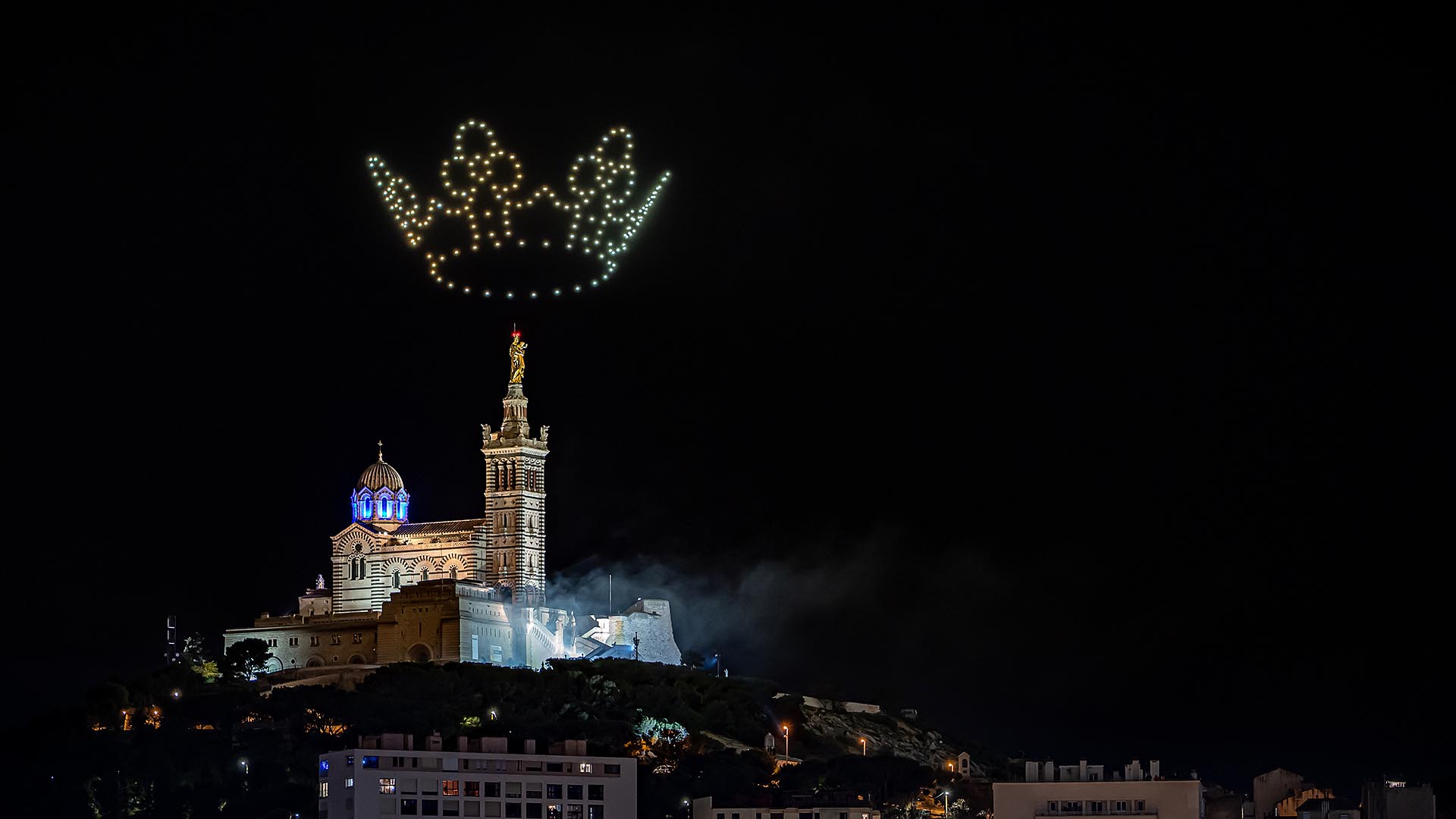
The arrival of new forms of hybrid shows is also changing practices. Drones, lighting devices, new visual languages: all of this modifies the way of photographing. But here again, Clément reminds us that each technology calls for a specific language. You do not photograph a drone tableau as you photograph a fireworks display. The temporalities, settings, and visual expectations differ profoundly.
His perspective therefore remains attentive, open, but always guided by the same demand: to understand what he is photographing in order to better reveal its singularity.
Photographing What Should Never Have Been Visible
If he had to summarize in one sentence what he seeks to capture in his images, Clément would say: “The magic of a moment that even those who were there did not know how to see.”
This phrase probably tells the essential. For his entire approach is there: to bring forth from luminous chaos a lasting, readable, embodied image that resists forgetting.
Among the locations he still dreams of photographing, Montreal attracts him greatly, particularly the Grands Feux Loto-Québec. But his imagination also brings him back, profoundly, to French heritage. Versailles, Chambord, Chantilly, Chenonceau… so many locations where the encounter between architecture, history, and pyrotechnics could give birth to exceptional images.
An absolute encounter, he says.
Through his photographs, Clément Sauvage does not simply seek to show a fireworks display. He seeks to extend its presence, to preserve its most accurate and sensitive trace. To prove, perhaps, that the ephemeral can sometimes become a form of permanence.
Profile
Clément Sauvage
Pyrotechnic Show Photographer
Engineer and entrepreneur, he develops a demanding approach to photography, where composition, light, and narrative of place intertwine to create distinctive images.
Also read:
Nicolas Guilitte, photographier le feu comme une mémoire vivante