The History of Pyrotechnics: From Chinese Origins to Contemporary Shows
Pyrotechnics refers to all techniques used to produce light and sound effects from controlled chemical reactions, particularly in fireworks.
Fireworks seem to have always been part of major celebrations. National holidays, festivals, sporting events, or musical performances: around the world, pyrotechnics accompany the most significant collective moments.
Yet, behind these few minutes of light in the sky lies a thousand-year history. From the first Chinese experiments to the golden age of Italian firework makers, through to contemporary pyrotechnic shows synchronized with music, pyrotechnics has continuously evolved alongside scientific and artistic progress.
A look back at the fascinating history of this art of light.
The Chinese Origins of Pyrotechnics
The exact origin of fireworks remains difficult to establish with certainty. Most historians nevertheless place their invention in China, between the 9th and 10th centuries.
During this period, the first forms of explosive powder appeared. The Chinese discovered that a mixture of charcoal, sulfur, and saltpeter—the famous black powder—produced a spectacular reaction when ignited.
Certain chronicles mention the use of bamboo tubes filled with powder, projecting flames and sparks to frighten enemies or ward off evil spirits.
A popular tradition attributes the invention of fireworks to Li Tian, a monk living in the city of Liuyang, in Hunan province. He is said to have used this explosive mixture to create the first firework bombs intended for celebrations.
Even today, Liuyang is considered the world capital of fireworks, producing a large portion of the fireworks used around the world.
The Arrival of Pyrotechnics in Europe
Through trade exchanges along the Silk Road, knowledge of black powder gradually reached Europe.
As early as the 13th century, Italy became one of the major centers of pyrotechnics. Italian firework makers developed a true school, combining chemical knowledge with a sense of spectacle.
In the princely courts of the Renaissance, fireworks accompanied major celebrations: weddings, military victories, or religious festivals.
Firework makers were no longer merely technicians. They became creators capable of composing visual spectacles, using architecture and space to stage light.
The Golden Age of Fireworks in France
In the 17th century, the pyrotechnic tradition also became established in France.
One of the first major fireworks displays was launched in 1615 in Paris, at Place des Vosges, to celebrate the marriage of Louis XIII and Anne of Austria.
Under the reign of Louis XIV, pyrotechnic shows became a major element of grand royal celebrations. At Versailles, fireworks were integrated into vast productions combining music, ephemeral architecture, and water features.
In the 18th century, the official position of firework maker to the king was entrusted to the famous Ruggieri family, which would leave a lasting mark on the history of European pyrotechnics.
The shows then became true artistic productions, involving architects, painters, engineers, and firework makers.
The Color Revolution in the 19th Century
Until the 19th century, fireworks remained relatively limited in their colors.
However, advances in chemistry enabled the introduction of metal salts, capable of producing spectacular colors:
-
strontium for red
-
copper for blue
-
sodium for yellow
-
calcium for orange
These discoveries profoundly transformed the aesthetics of pyrotechnic shows.
Fireworks gradually became inseparable from major popular celebrations, such as world’s fairs or national holidays.
Pyrotechnics in the Era of Modern Shows
In the 20th century, technological advances revolutionized the staging of fire.
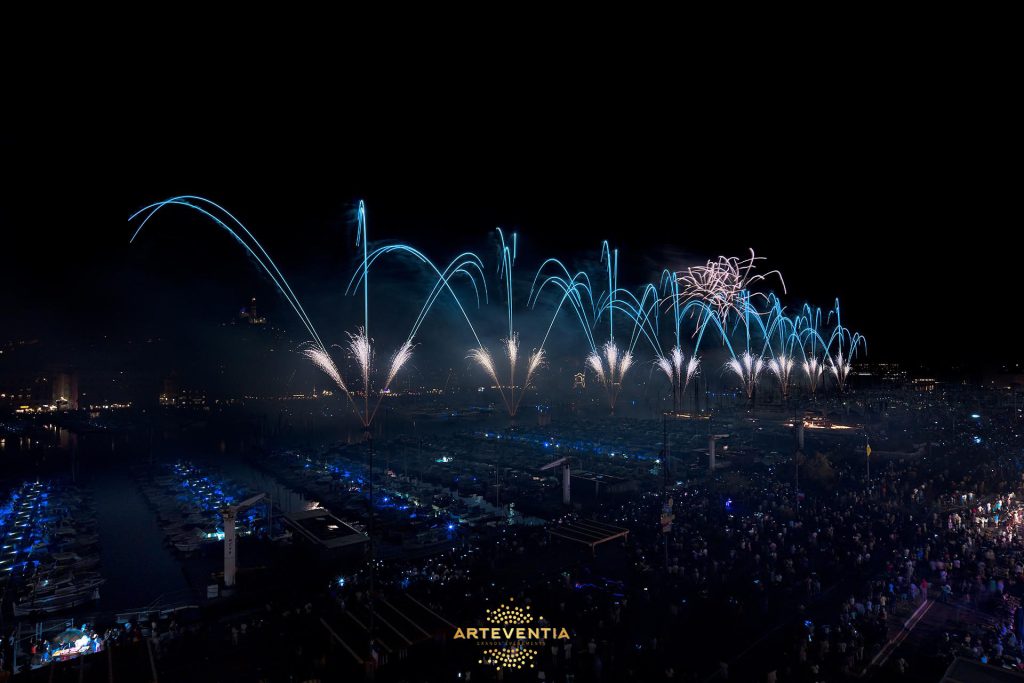
The introduction of electronic firing systems enabled extremely precise synchronization. Firework makers can now program effects to the hundredth of a second, opening the way to a new form of show design.
Pyrotechnics then moved closer to the world of music and live performance: fireworks are designed as visual choreographies synchronized with a soundtrack.
Today, major pyrotechnic shows combine artistic creation, computer programming, and technical mastery.
To understand how a contemporary fireworks show is created, you can also read this article:
An Art Still Evolving
The history of pyrotechnics has never stopped. Firework companies around the world continue to innovate, particularly during major international competitions where the best creators compete.
Each generation brings its own techniques, new effects, and vision of the show.
Thus, for more than a millennium, pyrotechnics has remained faithful to its original purpose: to amaze audiences by transforming the sky into an ephemeral stage.
Édouard Grégoire
Artistic Director – ARTEVENTIA