Fireworks or Drone Show: Is a Choice Truly Necessary?
In recent years, illuminated drone shows have been developing worldwide. In both media and tenders, the question often arises: will drones replace fireworks?
Some communities and organizers wonder if they now have to choose between these two forms of entertainment.
However, the answer is less simple than it seems.
It’s not about pitting one technology against another, but understanding that each possesses its own artistic language.
Two technologies, two forms of expression
Fireworks belong to a centuries-old tradition.
Their composition relies on energy, impact, and increasing intensity.
Pyrotechnic shows play with:
-
combustion
-
light
-
rhythm
-
sound power
-
spectacular use of space.
Drone shows, on the other hand, are based on a much more recent technology.
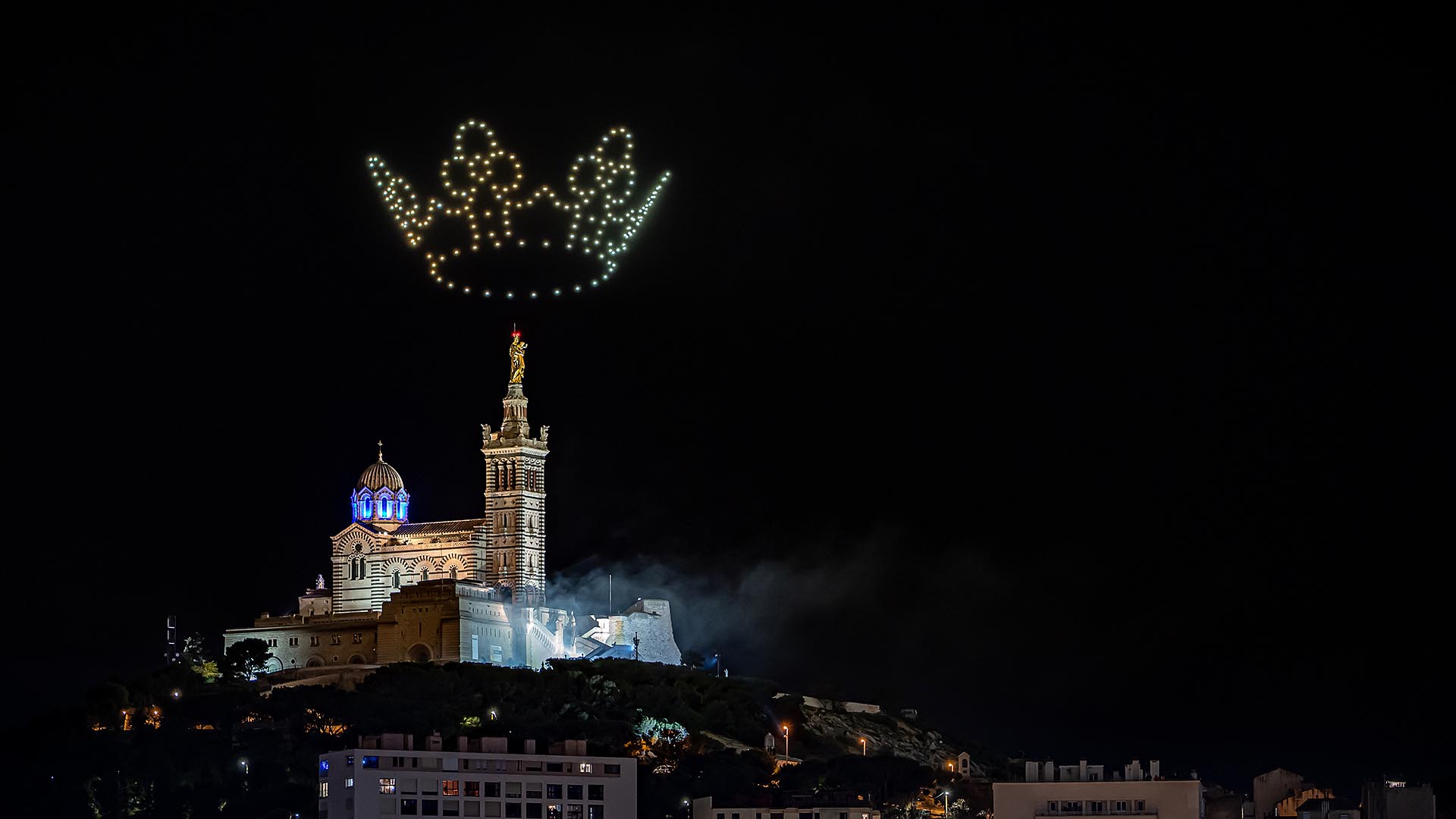
They allow for drawing in the sky with almost graphic precision: geometric shapes, logos, silhouettes, or collective movements become visible as an aerial choreography.
Where fireworks explode and radiate, drones compose and structure.
The former is explosive.
The latter is sculptural.

A Different Emotion
These two languages produce subtly different emotions.
A pyrotechnic show immediately affects the senses.
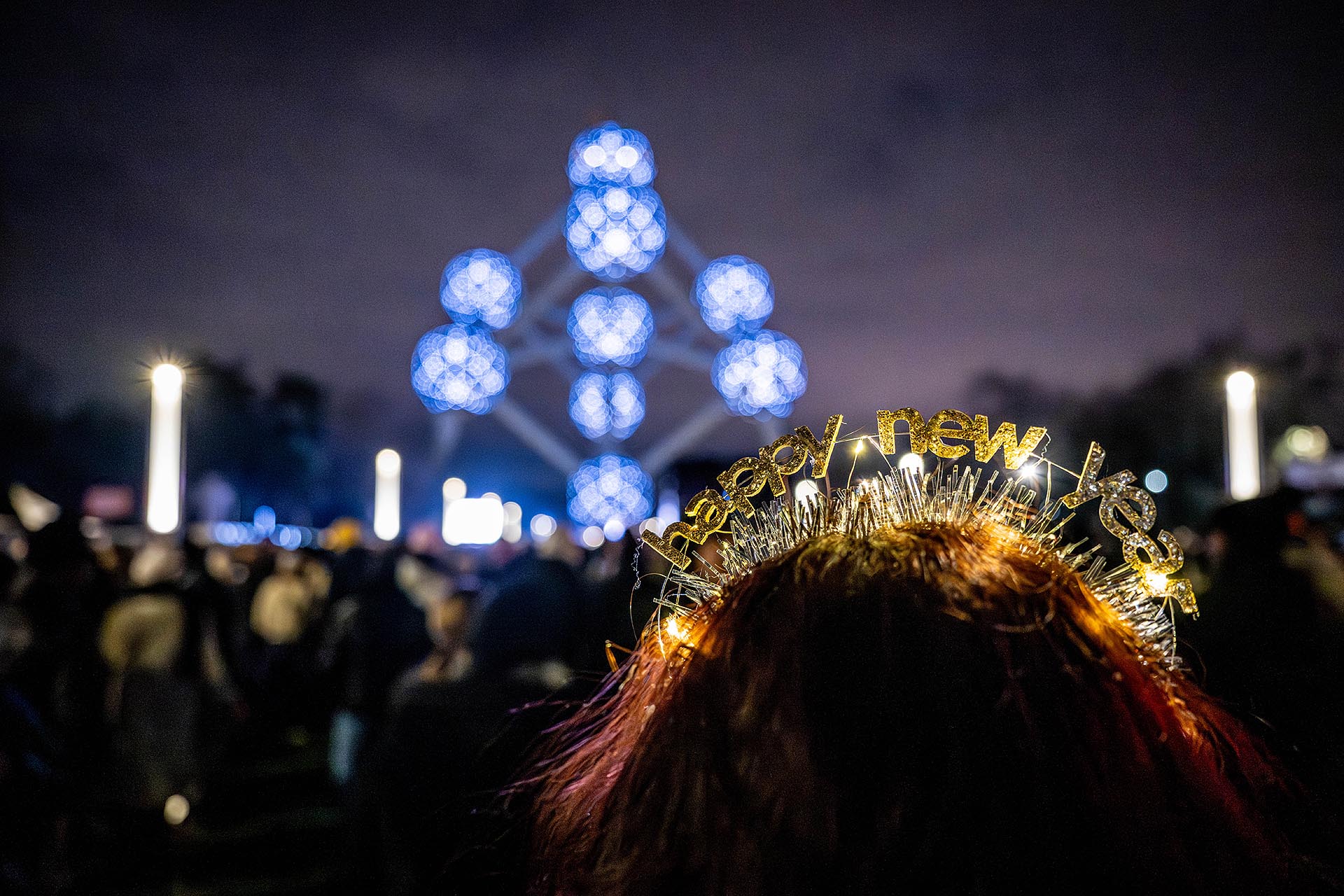
The rhythm of explosions, the vibration of sound, and the total occupation of the sky create a physical and collective reaction.
Drone shows, conversely, often induce a form of contemplation.
The gaze follows the movements of the machines, observes the progressive transformation of shapes, and discovers a precise visual narrative.
One evokes wonder through energy.
The other captivates with precision and graphic legibility.
The environmental challenge
The rise of drone shows is also accompanied by an environmental debate.
The drone show offers several obvious advantages:
there is no combustion, no fallout of materials, and trajectories are perfectly controlled.
However, it also involves significant technical logistics: equipment transport, batteries, control devices, and specific aerial authorizations.
For its part, pyrotechnics are also evolving.
For several years, manufacturers have been working on improving compositions, reducing residues, and ensuring the traceability of productions, particularly in Europe.
Simplistically opposing an “ecological” technology to a “polluting” one therefore does not reflect reality.
Each project must be studied according to its context and objectives.
The question of scale
Another often underestimated element is the scale of the show.
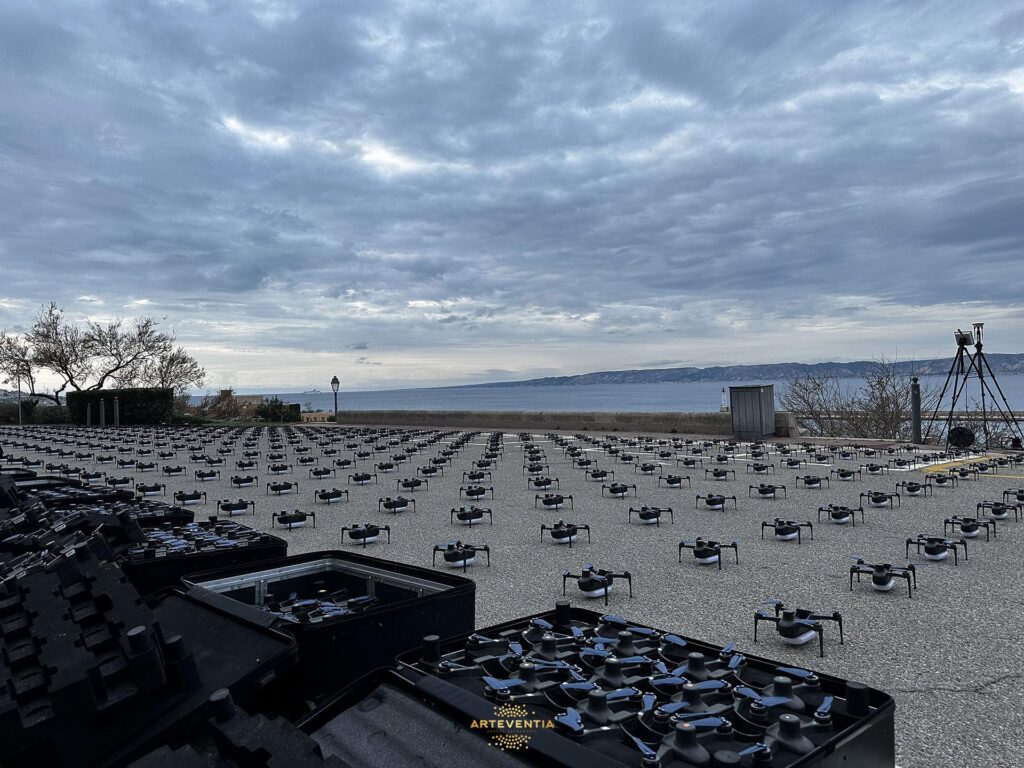
Today, a drone show requires a significant number of devices to produce true visual density.
In practice, a minimum of approximately 500 drones is often necessary to achieve a spectacular and legible result.
Below this threshold, the result may appear fragile or dispersed.
Fireworks, on the other hand, have a more flexible adaptability.
They can be scaled for different budgets while maintaining a strong visual and emotional impact.
The Emergence of Hybrid Shows
Rather than opposing these two technologies, many creators are now exploring their complementarity.
At ARTEVENTIA, we develop shows that we call Sky Choreography™: a visual language where multiple technologies interact to create an immersive experience.
In this approach:
-
drones structure space and define the narrative
-
pyrotechnics provide energy and emotion
-
light and lasers enhance the scenography
-
music sets the rhythm for the whole.
This combination enables a new artistic dimension: a show that is both clear, spectacular, and contemporary, as we have done on several occasions during the Marseille Christmas.

So, do you have to choose?
The real question is probably not:
fireworks or drone show?
The question is rather:
What experience do we want to offer the public?
A powerful heritage show?
A contemporary graphic fresco?
An immersive creation blending multiple technologies?
Each language has its place.
And when these technologies interact intelligently, they pave the way for a new generation of shows where innovation and emotion advance together.
In summary
Fireworks and drone shows are not competitors.
They are two different visual languages.
The choice always depends on:
-
the venue
-
the audience
-
the budget
-
the artistic intent
-
the message to be conveyed.
And when these languages meet in a coherent approach like Sky Choreography™, they give birth to shows where technology, narrative, and emotion respond to each other in the sky.
Also read: