Christophe Blanc, forty years of chasing emotion in the sky
There are passions that span a lifetime without ever losing their intensity. For Christophe Blanc, photography and pyrotechnics belong to this rare category: two ancient, deep, and constant impulses that joined forces several decades ago, never to be parted.
For nearly forty years, Christophe has photographed pyrotechnic displays with the same high standards, the same sensitivity, and a singular gaze that seeks less to document an event than to preserve its emotion. Behind each of his images lies a simple conviction: a firework display is more than just a luminous explosion. It is a moment of grace, a dialogue between a script, a location, and a memory.
A passion born in the red light of the darkroom
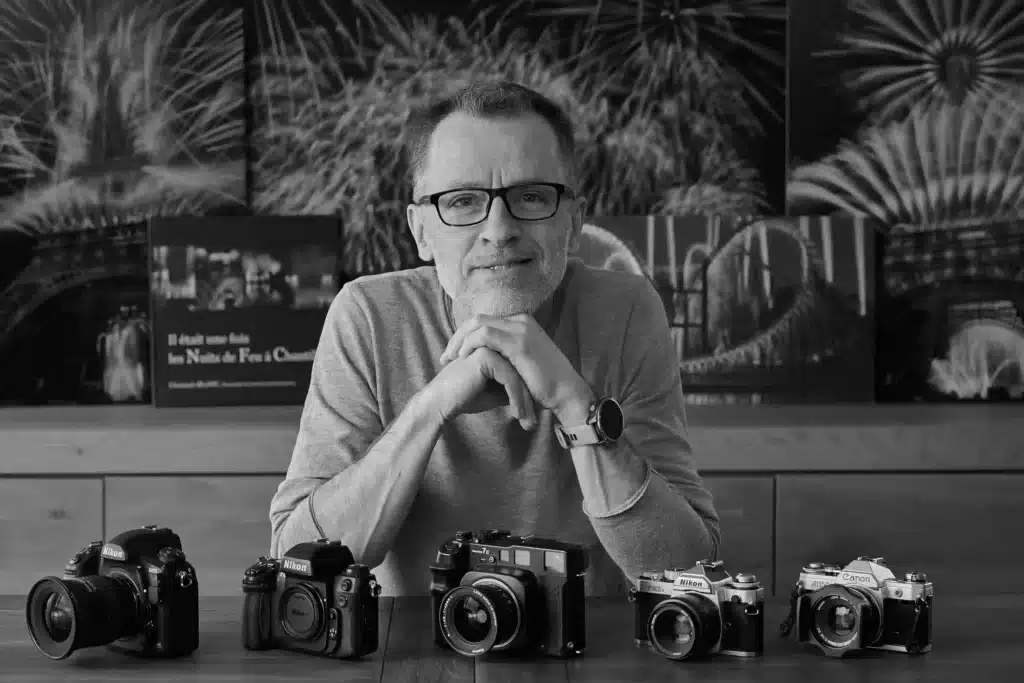
Photography has always been a part of Christophe’s existence. It was passed down to him early by his father, with whom he developed black and white prints as early as age 10, using an enlarger set up in the family bathroom. It was the era of film, of rolls carefully loaded into a Canon AT1, of waiting, of uncertainty, and above all, of that intact wonder the moment the image appeared in the developer bath.
That magic has never left him.
At the time, his favorite subjects were already revealing of a certain perspective: nature, architecture, family scenes. These themes still say something essential about his photography today: a taste for locations, attention to framing, and the desire to preserve a sensitive trace of what passes by.
When two passions finally meet
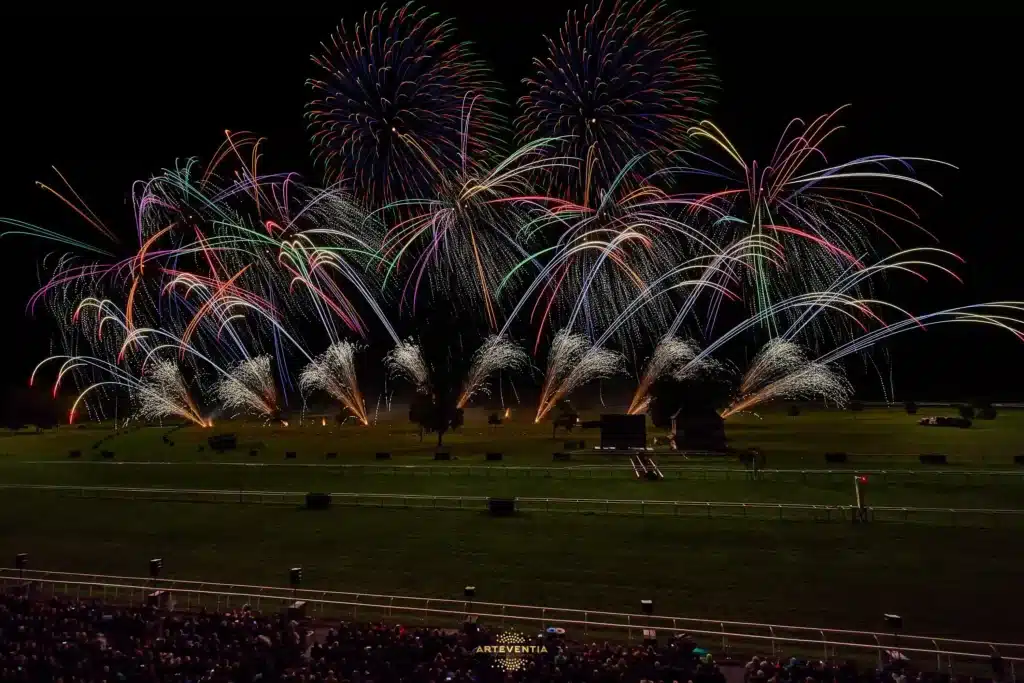
Since childhood, Christophe has also harbored a fascination for pyrotechnic displays. For a long time, his two passions moved in parallel without truly crossing paths. Then came a decisive moment: in 1987, he attended the first edition of the Nuits de Feu in the park of the Château de Chantilly.
There, the obvious became clear.
The venue, the power of the show, the emotion sparked by pyrotechnics in an exceptional heritage setting: everything converged to create the desire to finally unite his two worlds. Since then, photography and pyrotechnic art have become one in his career. This forty-year loyalty speaks volumes about the place this practice occupies in his life.
What moved him then, and still moves him today, is the possibility of capturing this ephemeral wonder—this moment that happens only once, right before you, and disappears almost immediately.
The film beginnings, between patience and surprise
Photographing fireworks in the film era obviously had nothing to do with the ease offered by digital technology today. Christophe remembers those years when neither the internet nor immediate previews existed, when every shot counted because it was limited by the length of the film. During large shows or competitions featuring multiple participants, it was sometimes necessary to change film in the dark, with all the dexterity and calm that required.
When working in medium format, the exercise became even more delicate.
And then there was the waiting. Results only appeared after several days, sometimes with joy, sometimes with disappointment. But this wait was part of the process, almost part of the photographer’s emotional apprenticeship. Each development brought its share of surprise, like a second show. At that time, his images had only his family circle as their first audience. Yet, even then, a lasting perspective was being built.
Mastered technique, always at the service of feeling
Christophe has never considered pyrotechnic photography an inaccessible discipline. For him, it relies on a few clear technical principles: working at the lowest possible sensitivity to best render the true colors of the effects, adapting the aperture to the light intensity, adjusting the exposure time according to the density of the show, and relying on simple but rigorous equipment.
A tripod to ensure stability.
A remote shutter release to avoid vibrations.
A camera body with all automatic settings disabled.
And, in his early days, that famous black card placed in front of the lens to protect the environment from overexposure or to exclude certain effects during very long exposures.
But in his eyes, all of this is just a means to an end. The success of an image does not depend solely on the setup. It requires, above all, feeling the show, immersing oneself deeply in it, and triggering the shutter at the right moment. In other words: technique alone is not enough. It is passion that drives the shot.
Forty years of shows, and still the same wonder
When someone mentions “more than twenty years” of following pyrotechnic displays, Christophe immediately corrects them with humor: it has been more like forty years. A longevity that has not weary him; quite the contrary. It has allowed him to see the evolution of products, the scripting of shows, synchronization with music, and new forms of pyrotechnic storytelling.
What still fascinates him today is precisely this ability of the show to renew itself without losing its emotional power. He takes as much pleasure in a major event as in a three-minute private firework display. Because what matters, ultimately, is not just the scale of the setup, but the writing of the show and the precision in the use of the products.
Emotion does not depend on volume. It depends on the intelligence of the gesture.
A gaze increasingly attentive to locations
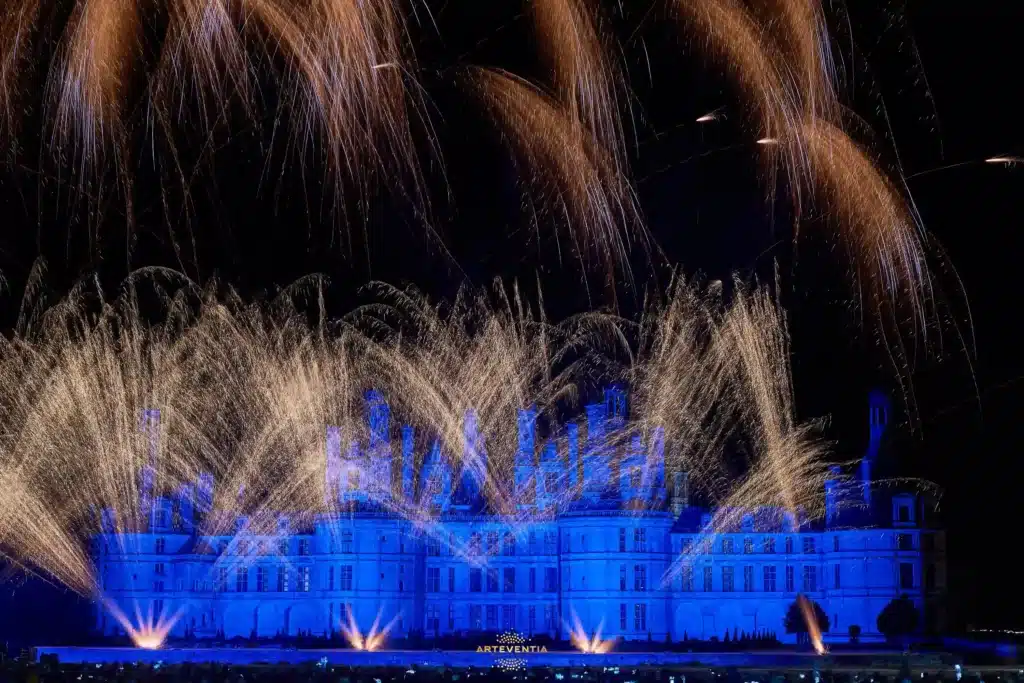
Over the years, Christophe’s gaze has become more refined and stronger. He is now more demanding, not only regarding the show itself but also the location in which it takes place. This dimension is essential for him: a firework display never floats in a vacuum. It intervenes in a landscape, reveals architecture, highlights a history, and temporarily transforms a space.
Christophe particularly enjoys shows designed in historical or atypical locations. He speaks with obvious affection for the gardens of our French châteaux, of which he is a fervent admirer, but also iconic sites like the Eiffel Tower or the City of Carcassonne, magnificently showcased during July 14th celebrations.
In his images, pyrotechnics do not just inhabit the sky. They dialogue with heritage.
Photographing the ephemeral
For Christophe, what makes pyrotechnic photography unique is that it confronts the photographer with an ephemeral event, discovered live, and impossible to replay. Certainly, current tools allow for the preparation of shots using increasingly realistic simulations, and he sees a definite advantage in this. These visualizations help anticipate framing, exposure times, and apertures, and secure the capture of sometimes very brief effects.
But despite these aids, the essential remains: you have to be there, in the right place, in the right state of attention.
When he photographs, Christophe seeks above all to convey an emotion. He knows that no image can ever fully equal the intensity of what he felt at the moment of the shot, but it must at least bear its trace. He has even, he says, forgotten to trigger the shutter because the emotion felt was so strong. Perhaps, precisely, the clearest sign of passion.
For him, a successful firework photo is an image in which emotion is present, and where the pyrotechnics truly enhance a location. Hence the extreme attention he pays to his framing.
Transmission as a natural extension of passion
Christophe’s work does not stop at taking the shot. It also includes an important educational dimension. He enjoys transmitting, advising, and sharing what he has learned. He mentions often crossing paths with other photographers at shows and never being stingy with recommendations.
The arrival of digital technology has profoundly changed learning. Where film imposed a slow progression, made of delayed trials and uncertainties, digital allows the amateur to see the result immediately and quickly adjust parameters for the next image. The learning curve has become much faster.
His advice to those who would like to start is, moreover, very simple: do not have any apprehension. A camera body, a tripod, a remote shutter release, and you must begin.
If he had to point out a frequent mistake among beginners, it would be exposure management. Pyrotechnic effects are very bright while the surroundings remain very dark. It is therefore necessary to carefully monitor the screen after each shot to correct the aperture and adjust the next image.
Between anticipation and instinct
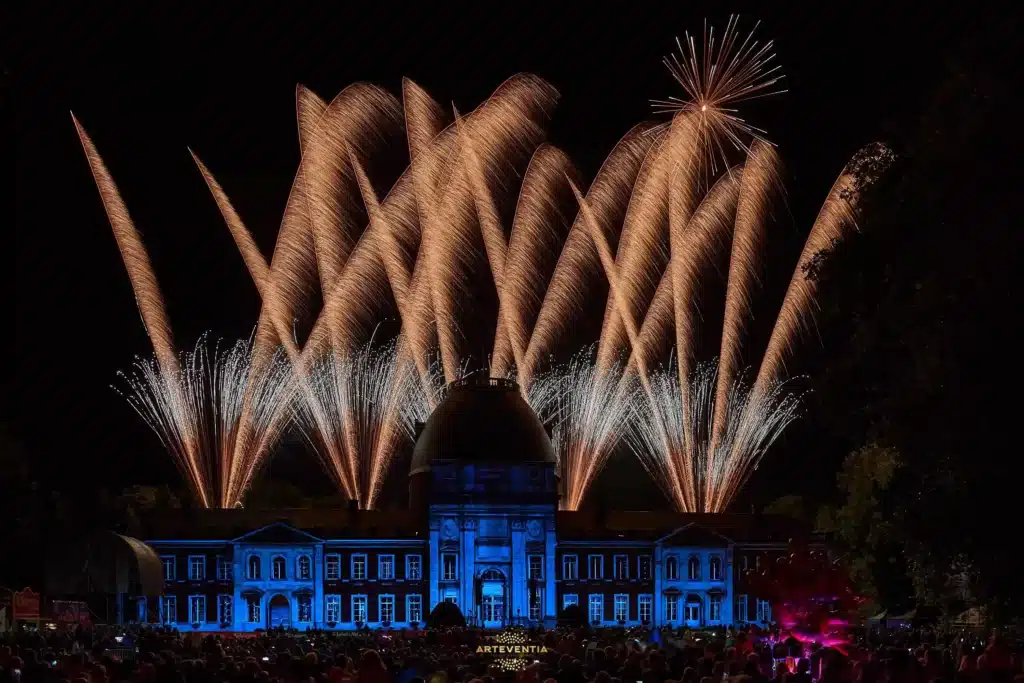
Christophe appreciates having access to a computer simulation of the show when it exists. It is a valuable tool for preparing framing, anticipating exposures, and identifying important sequences. But it does not replace being on the ground. One must also look for the right location, the one that will best combine the show and the venue.
His rule could be summarized in a few words: arrive early.
With experience, he also observes shows differently. He pays increasing attention to the writing and follows certain designers faithfully, precisely because he is sensitive to the way their writing gives birth to emotion.
Significant locations, foundational memories
If there is one event that has particularly marked his career, it is of course the Nuits de Feu in Chantilly. Organized within the grounds of the château’s park, this international competition, which was held from 1987 to 2008 over sixteen editions, was an exceptional field for Christophe. He was the official photographer, and this adventure even led to the publication of a book.
These are, he says, immense memories.
Having worked alongside pyrotechnic companies in this setting also allowed him to open many doors to other shows. But fundamentally, what he seeks remains identical: strong writing and a location that deserves to be revealed. It is this requirement that can lead him to drive for several hours to photograph a four-minute private show, from which he may return with only five images… and stars in his eyes.
Light, timing, density: precision writing
For Christophe, the technical key to a good image lies in two inseparable elements: timing and light.
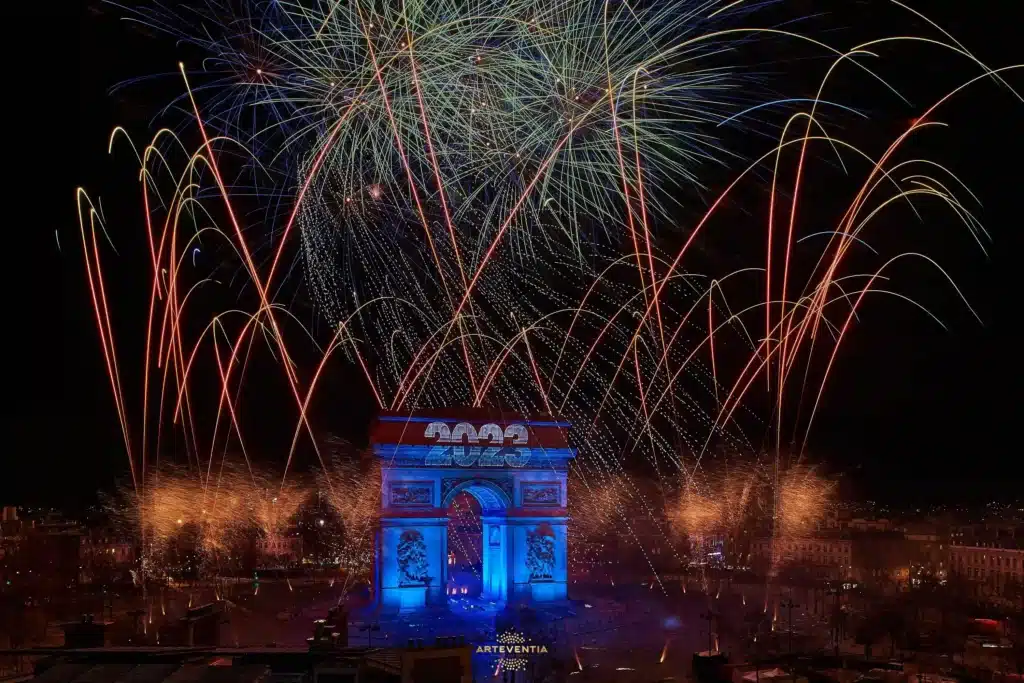
Light first, because its intensity varies enormously during a show, and one must succeed in preserving both the pyrotechnic effects and the environment in a single shot. Density second, because an excess of accumulation can produce what he aptly calls a “noodle pack effect,” where the graphics become blurred and lose their legibility.
A successful photograph must, on the contrary, do justice to the designer’s graphic choices.
From film to RAW: keeping control over the entire image chain
The question of retouching also reveals an important part of his approach. In the film era, the very notion of retouching did not exist in the same way. Christophe quickly realized that the paper print produced by the laboratory already constituted an interpretation of his image, particularly in the treatment of shadows and highlights. This led him to invest early in a film scanner, in order to regain control over the development chain.
Today, he works digitally in RAW format, which he then develops in Capture One. This workflow allows him to regain valuable latitude over shadows and highlights. He admires the capabilities of current sensors, which are able to absorb considerable differences in brightness, something that was once much more delicate to manage.
An image to prolong the memory
When Christophe photographs a show, he feels emotion, sometimes even chills. An emotion so strong that it can almost make him forget the camera. He readily admits that behind the viewfinder, one does not enjoy the show one hundred percent. But he has already forgotten the camera to live the moment two hundred percent.
This sincerity says a lot about his relationship with the image.
For him, photography plays an essential role in the memory of a pyrotechnic display. It constitutes a memory of the pyrotechnic art itself. Unlike video, which transcribes movement and music, photography freezes chosen moments, fragments of writing, graphic compositions, and dialogues between light and the environment. It can thus decorate a wall, illustrate a book, or span time in a different way.
Looking toward the future
Regarding the evolution of firework photography, Christophe remains attentive to advancements in digital sensors, which he considers the main element of this practice. Their ability to reveal details in shadows while supporting very high lights is already remarkable and will undoubtedly continue to simplify shooting even further in the years to come.
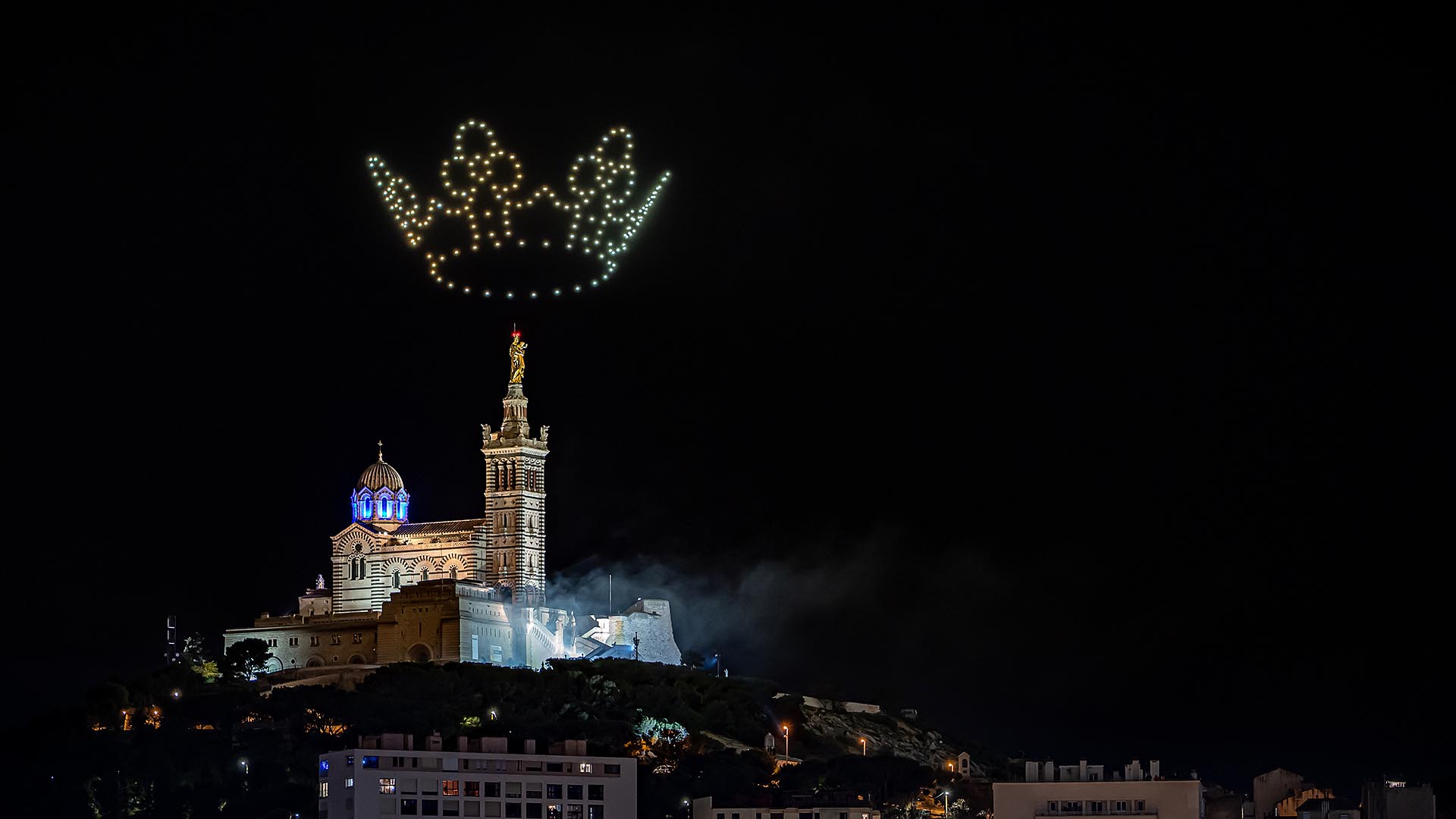
As for new technologies like drones or hybrid forms, they do not fundamentally change his photographic practice on fireworks. He does use a drone during his travels, but not for this type of subject: it would not be able to remain perfectly still for a long exposure, and video does not interest him in this context.
Freezing the moment, without ever diminishing it
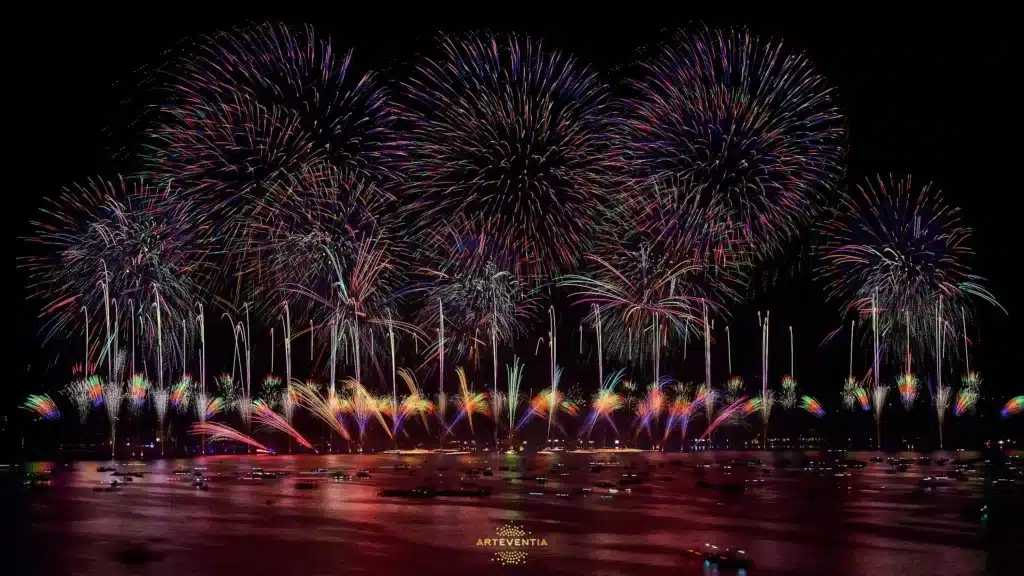
If he had to summarize in one sentence what he seeks to capture in his images, Christophe would simply say: freezing the instant, a moment, even if it may represent a few dozen seconds.
This formula suits him. It speaks at once of the precision of the gesture, the awareness of duration, and this very personal way of making lasting what is, by nature, not.
And if he still has a photographic dream, it is located on the other side of the world: the December 31st show in Sydney, over the Harbour Bridge. But for him, such a project is not thought of as a simple photo shoot. It would also be a family trip, a long period of time, an exploration, because Christophe is also passionate about travel—and his camera never leaves his side.
With him, fundamentally, everything always comes together: locations, light, memory, emotion.
Profile
Christophe Blanc
Pyrotechnic Display Photographer
Passionate about photography and pyrotechnics since childhood, he has spent forty years building a sensitive and demanding perspective, where light, location, and emotion converge to give birth to lasting images.
Also worth reading:
Photographe de feux d’artifice : le regard de Clément Sauvage